


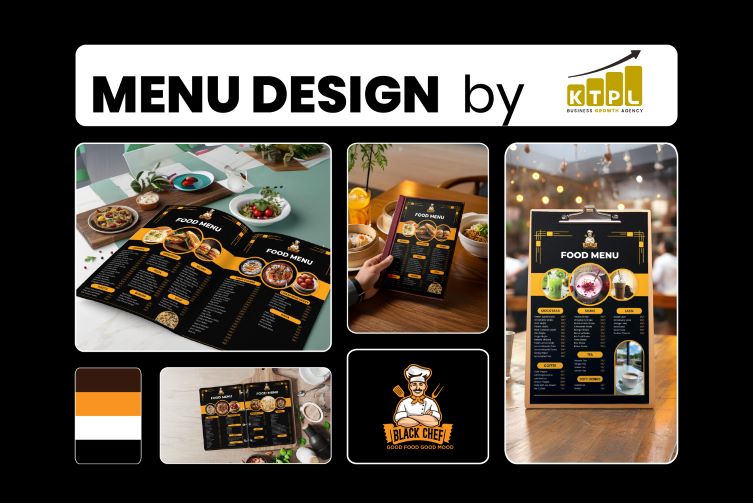
A menu card is often the first silent welcome a restaurant gives to its guests. Before a single dish is served or a conversation begins, the menu communicates the restaurant’s personality, quality, and professionalism. In the food industry, a menu card is not just a list of items. It is a functional business tool that influences customer decisions, ordering speed, and overall dining comfort.
This detailed case study showcases a menu card design project completed for Black Chef, a restaurant brand based in Delhi, owned by Mr. Taresh Bhardwaj. The project was handled by KTPL – Business Growth Agency with a clear goal of creating a menu that feels organized, readable, and effortless to use during everyday restaurant operations.
Client Background and Brand Overview
Black Chef is a restaurant operating in the competitive food industry in Delhi, where customers expect clarity, speed, and comfort while ordering. The brand serves a diverse audience, including first-time visitors and regular diners, making menu usability a critical factor.
Mr. Taresh Bhardwaj wanted a menu card that reflects professionalism while remaining simple and practical. The requirement was clear. The menu should help customers choose faster, reduce confusion, and support staff during peak dining hours without compromising visual appeal.
Project Summary
- Client Name – Mr. Taresh Bhardwaj
- Brand Name – Black Chef
- Industry – Food and Restaurant
- Client Location – Delhi
- Project Type – Menu Card Design
- Agency – KTPL – Business Growth Agency
Industry Context and Project Requirements
The food and restaurant industry demands design solutions that balance aesthetics with functionality. Unlike digital designs, a printed menu card is handled multiple times daily and must perform consistently in real-world conditions.
The project requirements focused on – creating a clean and structured menu layout, organizing food categories logically, maintaining readability under restaurant lighting, ensuring print-friendly formatting, and aligning the design with the brand identity of Black Chef.
These requirements guided every design decision throughout the project.
Understanding the Importance of Menu Card Design
Menu card design plays a major role in shaping customer perception. A cluttered menu can overwhelm guests, while a well-structured one builds confidence and trust. Customers often decide what to order within seconds, which makes clarity essential.
For this project, the menu was treated as a silent guide. It needed to support natural scanning, reduce decision fatigue, and help customers feel comfortable while exploring food options. This approach ensures that the menu enhances the dining experience instead of becoming a barrier.
Design Objective and Creative Vision
The primary objective of the menu card design was to create a smooth and intuitive experience for customers. The creative vision focused on simplicity, balance, and flow rather than decorative complexity.
The design aimed to deliver – a clear visual hierarchy, easy navigation across food categories, readable typography for all age groups, balanced spacing to avoid clutter, and a layout that supports fast decision-making during busy hours.
This vision ensured the menu card remains practical while still looking professional.
Research and Planning Phase
Before starting the design, the team at KTPL – Business Growth Agency studied how customers interact with restaurant menus. Understanding customer behavior helped shape the layout and structure of the menu card.
The planning phase included – analyzing food categories and item grouping, identifying the best order for sections, planning font sizes for headings and items, deciding spacing for visual comfort, and designing with long-term print usage in mind.
This groundwork allowed the final design to feel intentional and well-organized.
Menu Structure and Layout Strategy
The menu layout was designed to feel natural and effortless. Each section flows smoothly into the next, guiding customers without forcing attention.
The layout strategy focused on – logical category sequencing, consistent alignment across sections, clear separation between food groups, predictable placement of item names and prices, and an overall structure that feels calm and balanced.
This structured approach ensures that customers can scan the menu quickly without feeling overwhelmed.
Typography Selection and Readability
Typography is one of the most important elements of menu card design. For Black Chef, clean and professional fonts were selected to support readability and brand tone.
Typography decisions ensured – strong contrast between headings and item text, comfortable line spacing for easy reading, minimal font variations to maintain clarity, and consistent styling across the entire menu.
This typography system helps customers read effortlessly, even during busy dining hours.
Spacing and Visual Balance
Proper spacing improves both aesthetics and usability. Crowded menus can cause confusion, while balanced spacing creates visual comfort.
The design used spacing strategically to – separate categories clearly, prevent text from appearing cramped, guide the eye naturally from one section to another, and improve overall scanning speed.
Balanced spacing also helps staff quickly locate items when assisting customers.
Print-Friendly Design Considerations
Since menu cards are physical assets, print quality and durability were key considerations. The design was optimized to maintain clarity after printing and repeated use.
Print-friendly considerations included – avoiding overly thin fonts, maintaining consistent margins, ensuring clear text contrast, and designing a layout that remains readable even after wear.
This ensures the menu continues to perform well over time.
Final Outcome and Results
The final menu card design reflects professionalism, clarity, and thoughtful structure. It supports both customers and restaurant staff, making daily operations smoother.
The results delivered to Black Chef include – improved customer confidence while ordering, faster decision-making, reduced confusion during peak hours, a professional brand presentation, and a menu card that aligns with the restaurant’s quality standards.
This project highlights how effective menu card design can positively influence restaurant performance.
Business Impact of the Menu Card Design
A well-designed menu card directly supports business growth. It improves customer satisfaction, reduces ordering errors, and strengthens brand perception.
For Black Chef, the menu card now acts as a silent salesperson that guides customers naturally and supports staff efficiency. This leads to a better dining experience and repeat visits.
Why Menu Card Design Matters in the Food Industry
In the food industry, menu card design is a critical part of customer experience. It connects the kitchen, service staff, and guests through clear communication.
Strong menu card design helps restaurants by – building trust, improving engagement, guiding attention, supporting daily operations, and enhancing overall brand value.
Final Thoughts
This menu card design case study demonstrates how clarity, structure, and thoughtful design choices can elevate a restaurant’s customer experience. A menu that feels easy to read and well-organized builds comfort, confidence, and trust from the first interaction.
What makes a menu easy for you to choose from – layout, clarity, or design balance? Share your thoughts in the comments and join the discussion.
Frequently Asked Questions
Have questions? We’ve answered some of the most common queries to help you understand the topic better
Q1. What is menu card design and why is it important for restaurants
Menu card design is the process of organizing food items and categories in a clear and structured layout. A professionally designed menu card improves readability, enhances customer experience, speeds up ordering, and supports smooth restaurant operations.
Q2. How does professional menu card design improve customer experience
Professional menu card design improves customer experience by reducing confusion and decision fatigue. Clear layout, readable typography, and logical flow help customers choose comfortably and confidently.
Q3. Why should restaurants invest in restaurant menu design
Restaurants should invest in restaurant menu design because the menu directly affects customer perception and ordering behavior. A well-designed menu builds trust, improves engagement, and reflects brand professionalism.
Q4. What elements make a menu card easy to read
An easy-to-read menu card includes clear headings, clean fonts, balanced spacing, logical food grouping, and a print-friendly layout that works well in real restaurant environments.
Q5. How does menu card design support restaurant business growth
Menu card design supports restaurant business growth by improving customer satisfaction, reducing order errors, increasing perceived food value, and strengthening the overall dining experience.
Ready to Design a Menu Card That Reflects Your Restaurant Brand
At KTPL – Business Growth Agency, we specialise in creating custom, professional menu card designs that communicate your restaurant’s identity, improve customer experience, and support daily business operations. Whether the requirement is a clean, modern, minimalist, or premium menu layout, our team translates your vision into a clear and functional design that works seamlessly in real restaurant environments. Ready to enhance your dining experience with a menu card that feels organized, readable, and professional? Connect with us today and let us design a menu that truly represents your brand.
👉 Visit https://kirnanitechnologies.com
📞 Call us at +91 95097 77888
📧 Email us at contact@kirnanitechnologies.com


