


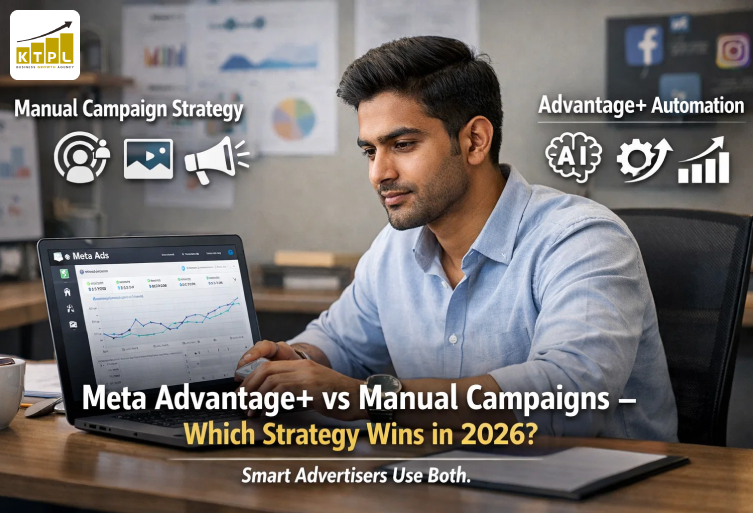
Digital advertising continues to evolve at a rapid pace. By 2026, marketers are working in a landscape where artificial intelligence plays a larger role in campaign optimization than ever before. Businesses are no longer simply choosing between automated tools and manual control. Instead, the real challenge is understanding how to combine both approaches to create sustainable growth.
One of the most debated topics among marketers today is the comparison between Meta Advantage+ campaigns and Manual campaigns. Some businesses rely heavily on automation to scale results quickly, while others prefer manual targeting and bidding for strategic control. The truth is that both approaches serve different purposes in a modern marketing strategy.
For brands focused on long-term growth, the question is not which option is better. The real question is how to use each strategy at the right stage of a campaign.
This guide explores how Advantage+ campaigns and manual campaigns work in 2026, their strengths, limitations, and how businesses can combine them effectively for better results.
The Evolution of Meta Advertising in 2026
Meta’s advertising platform has changed dramatically over the last few years. Earlier, marketers spent significant time selecting detailed audience interests, placements, and bidding strategies. Campaign performance depended heavily on manual optimization.
Today, Meta’s machine learning system processes billions of behavioral signals every day. These signals include browsing behavior, engagement patterns, purchasing history, and interaction with ads. As a result, the platform can automatically identify users who are more likely to convert.
This shift has led to the rise of Advantage+ campaigns, which automate much of the targeting and optimization process.
However, automation does not remove the need for strategic thinking. Businesses still need to test messaging, understand audience psychology, and manage budgets carefully. That is where manual campaigns remain valuable.
What Are Meta Advantage+ Campaigns?
Meta Advantage+ campaigns are designed to automate several parts of the advertising process. Instead of manually selecting multiple audience segments and placements, advertisers provide campaign objectives and creative assets while the platform’s AI handles the optimization.
The system analyzes user data, engagement signals, and past campaign performance to determine where ads should appear and who should see them.
This approach helps businesses reach a broader audience while reducing manual work.
Key Characteristics of Advantage+ Campaigns
- Automated Audience Targeting
The platform identifies potential customers based on behavioral patterns instead of strict interest targeting. - Placement Optimization
Ads automatically appear across different placements such as feeds, stories, reels, and other formats depending on where performance is strongest. - Creative Delivery Optimization
Meta tests different variations of creatives to determine which combination generates the best results. - Learning-Based Optimization
The algorithm continuously learns from campaign data and improves targeting over time.
Because of these capabilities, Advantage+ campaigns are particularly effective for businesses with a strong conversion history and a consistent stream of campaign data.
When Advantage+ Campaigns Perform Best
Advantage+ campaigns perform best in environments where there is enough data for the algorithm to learn quickly. Businesses that generate frequent conversions usually see stronger results.
Ideal Use Cases
E-commerce Businesses
Online stores running product campaigns often benefit the most from automated scaling. With multiple products and frequent purchases, the system can easily detect buying patterns.
High-Volume Lead Generation
Companies generating a large number of leads each week can use Advantage+ campaigns to reach broader audiences efficiently.
Scaling Proven Offers
When an offer has already proven successful in testing campaigns, Advantage+ can amplify its reach.
Conversion Data Requirement
For effective optimization, campaigns typically perform best when generating around 50 or more conversions per week. This provides enough data for Meta’s system to identify patterns and optimize delivery.
Without consistent conversion signals, automation may struggle to produce reliable results.
The Limitations of Advantage+ Campaigns
Although Advantage+ campaigns provide impressive scalability, they are not perfect for every situation.
One common challenge is the lack of granular control. When most targeting decisions are automated, marketers have limited visibility into exactly why certain audiences are performing well.
Another concern is creative dependency. Since targeting is largely automated, the quality of ad creative becomes the most important factor. Poor messaging or weak visuals can reduce campaign performance regardless of the algorithm.
Businesses operating in highly competitive niches may also find it difficult to maintain unique brand messaging when relying entirely on automated optimization.
For these reasons, many marketers continue to rely on manual campaigns to maintain strategic flexibility.
Understanding Manual Campaigns
Manual campaigns allow marketers to control every major element of an advertising campaign. This includes audience targeting, bidding strategies, placement selection, and budget allocation.
While this approach requires more effort, it provides deeper insights into audience behavior and campaign performance.
Key Features of Manual Campaigns
Marketers can create detailed audience segments based on interests, behaviors, demographics, and engagement history.
Manual campaigns allow advertisers to test multiple creatives and messaging variations in controlled environments.
Businesses can apply bidding strategies such as cost caps or return-on-ad-spend targets to maintain predictable spending.
Manual setups make it easier to target users who have previously interacted with a website, video, or social media content.
Because of these advantages, manual campaigns are often used for experimentation and strategic insights.

When Manual Campaigns Are Most Effective
Manual campaigns play an essential role when marketers need detailed control over campaign variables.
Testing New Creative Ideas
Before scaling any campaign, businesses need to understand which creative approach resonates with their audience. Manual campaigns allow multiple creatives to be tested simultaneously without heavy automation interference.
Niche Audience Targeting
Some industries serve highly specific audiences. In these cases, manual targeting helps ensure that ads reach the right people rather than relying entirely on algorithmic assumptions.
Retargeting Strategies
Retargeting campaigns often require specific messaging depending on the stage of the customer journey. Manual campaigns allow businesses to create tailored messaging for website visitors, video viewers, or abandoned cart users.
Brand Messaging Protection
Companies with strong brand identities may prefer manual oversight to ensure ads maintain a consistent tone and message.
The Hybrid Strategy That Wins in 2026
In 2026, the most successful marketing strategies combine automation with manual control.
Instead of choosing one approach, smart advertisers use each campaign type for a different purpose.
Advantage+ as the Scaler
Advantage+ campaigns work best when businesses want to expand reach and increase conversion volume. Once a campaign has proven its effectiveness, automation can help deliver it to a wider audience.
Manual Campaigns as the Strategist
Manual campaigns are used to test creative ideas, explore niche audiences, and gather insights that feed automated systems.
This relationship creates a powerful feedback loop.

How the Hybrid Approach Works
The hybrid approach allows businesses to combine the discovery power of manual campaigns with the scaling capability of Advantage+ campaigns.
Step 1: Discovery Phase
Start with manual campaigns to test new offers, creative formats, and audience segments.
- Winning ad creatives
- Effective messaging angles
- High-performing audience segments
Step 2: Performance Validation
Once a campaign generates consistent engagement and conversions, marketers can analyze the results to determine which elements performed best.
Step 3: Scaling Phase
The winning creatives and messaging are then introduced into Advantage+ campaigns, allowing the algorithm to distribute ads across a much larger audience.
Step 4: Continuous Testing
Even after scaling, manual campaigns should continue running smaller experiments. These insights help maintain performance and identify future opportunities.
The Growing Importance of Creative Strategy
As targeting becomes increasingly automated, creative strategy becomes the most important competitive advantage.
In 2026, advertisers who succeed focus heavily on storytelling, user-generated content, and authentic brand communication.
Creative Elements That Drive Results
Video continues to dominate social media engagement. Brands that create compelling short videos often see stronger conversion rates.
Real customer experiences create trust and encourage engagement.
Ads that communicate benefits quickly tend to perform better in crowded feeds.
Since most social media users browse on mobile devices, ads must be designed for smaller screens.
When creative quality improves, both manual campaigns and Advantage+ campaigns perform significantly better.
First-Party Data Is Becoming Essential
Another important factor in campaign success is first-party data.
With increasing privacy regulations and changes in tracking technology, businesses must rely more on data collected directly from their audience.
- Email subscribers
- Website visitors
- Past customers
- Content engagement data
When combined with strong creative strategy, first-party data significantly improves campaign results.
Budget Allocation Between Campaign Types
One common question businesses ask is how to divide advertising budgets between manual campaigns and Advantage+ campaigns.
While the exact allocation varies by industry, many marketers follow a balanced approach.
A Practical Budget Framework
Used for scaling proven campaigns and generating consistent conversions.
Dedicated to testing new ideas, retargeting audiences, and exploring niche opportunities.
This structure allows businesses to maintain steady growth while continuing to innovate.

Common Mistakes Businesses Should Avoid
Even experienced marketers sometimes make mistakes when running Meta campaigns.
Relying Only on Automation
Completely abandoning manual campaigns can limit innovation and reduce insight into audience behavior.
Ignoring Creative Testing
Without continuous creative experimentation, campaigns eventually lose effectiveness.
Insufficient Conversion Tracking
Accurate tracking is essential for algorithm optimization. Without reliable data, automated systems cannot learn effectively.
Scaling Too Quickly
Campaigns should reach stable performance before being scaled aggressively.
Avoiding these mistakes helps maintain consistent campaign performance.
Why Businesses Work With Growth Agencies
Running successful advertising campaigns in 2026 requires a combination of technical expertise, creative strategy, and data analysis.
Many businesses partner with specialized agencies to manage this complexity.
KTPL – Business Growth Agency helps companies design performance-focused advertising strategies that combine manual insights with AI-powered scaling. By analyzing campaign data, testing creative strategies, and optimizing budget allocation, businesses can achieve consistent growth in competitive markets.
Final Thoughts
The debate between Meta Advantage+ campaigns and manual campaigns often creates confusion for businesses entering digital advertising.
However, the reality in 2026 is clear.
Automation alone cannot replace strategic thinking, and manual control alone cannot match the efficiency of advanced algorithms.
The most successful approach combines both systems.
Manual campaigns provide the experimentation and insights needed to understand audience behavior. Advantage+ campaigns use those insights to scale successful campaigns to a much larger audience.
Businesses that adopt this hybrid strategy gain the best of both worlds: precision and scalability.
Instead of asking which approach is better, marketers should focus on how to integrate both effectively. This balanced strategy allows brands to innovate, maintain strong messaging, and achieve sustainable growth in an increasingly competitive digital landscape.
FAQs
Have questions? We’ve answered some of the most common queries to help you understand the topic better
Q1. Are Advantage+ campaigns better than manual campaigns?
Advantage+ campaigns are excellent for scaling campaigns quickly, but manual campaigns remain important for testing and strategic control.
Q2. How long does it take to see results from SEO?
Most campaigns perform best when generating around 50 conversions per week, allowing the algorithm to learn and optimize effectively.
Q3. Do manual campaigns still matter in 2026?
Yes. Manual campaigns help marketers test creatives, target niche audiences, and gather insights that automated systems can later scale.
Q4. Should businesses completely switch to automated advertising?
Relying entirely on automation can reduce strategic flexibility. A hybrid strategy that combines both approaches usually produces better long-term results.
Q5. What is the most important factor for campaign success in 2026?
Creative quality and first-party data are now the strongest drivers of campaign performance.
Want To Grow Your Business - Connect With KTPL
KTPL – Business Growth Agency, a creative solutions and business growth agency from India.
👉 Visit https://kirnanitechnologies.com
📞 Call us at +91 95093 33000
📧 Email us at contact@kirnanitechnologies.com


