


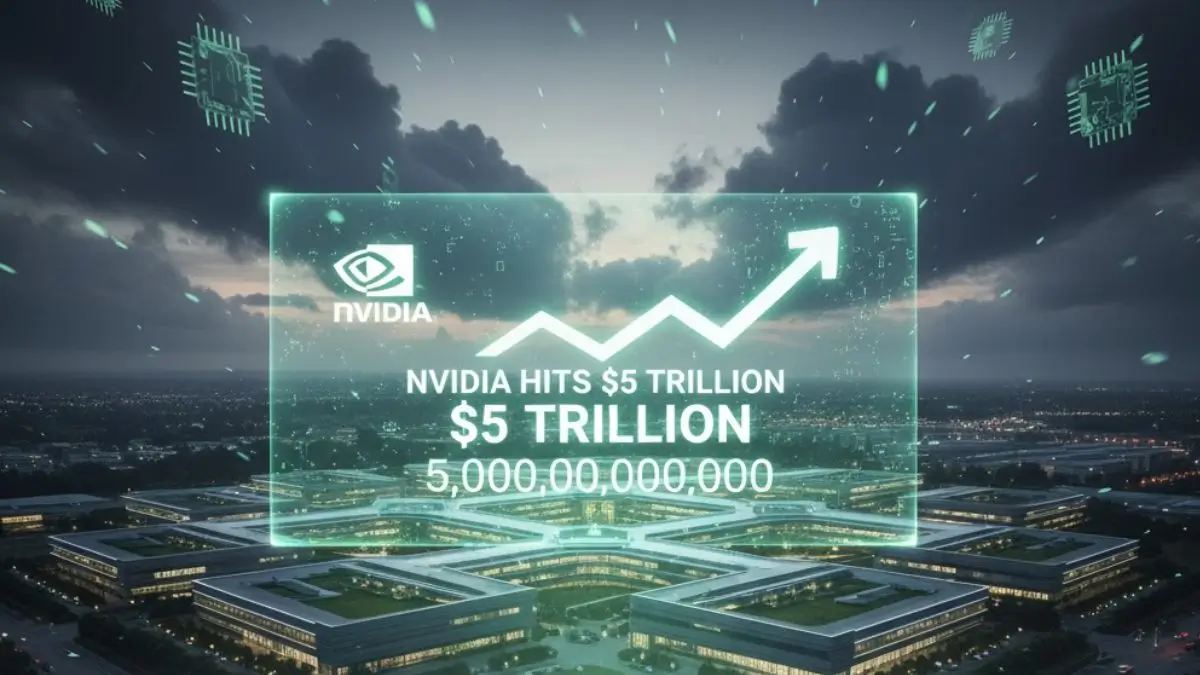
The world of technology just witnessed another historic milestone — Nvidia, the leading AI chipmaker, has reached a stunning $5 trillion market valuation. This record-breaking achievement cements Nvidia’s dominance in the rapidly growing artificial intelligence industry, reshaping how the world views the future of computing, innovation, and data infrastructure.
From powering advanced AI models to building next-gen supercomputers, Nvidia is not just riding the AI wave — it’s building it. Let’s explore how Nvidia reached this incredible valuation, what it means for the AI industry, and where the tech world goes from here.
The Rise of Nvidia — From Gaming to Global AI Leader
Once known primarily for its graphic processing units (GPUs) for gamers, Nvidia has transformed into the heartbeat of the artificial intelligence ecosystem. Its powerful chips are now the foundation for AI data centers, autonomous vehicles, machine learning applications, and supercomputing systems used by governments and tech giants worldwide.
Over the past few years, the company’s revenue has skyrocketed as global demand for AI chips and cloud infrastructure has exploded. Every major AI model, from ChatGPT to Gemini, runs on Nvidia GPUs — giving the company an unmatched competitive edge.
Nvidia’s $5 Trillion Milestone: A Turning Point in Tech
Reaching a $5 trillion valuation makes Nvidia one of the most valuable companies in the world, surpassing even traditional giants like Apple and Microsoft in momentum. This moment represents a turning point not only for Nvidia but also for the entire semiconductor and AI industry.
The company’s explosive market growth reflects how AI hardware has become the backbone of modern innovation. As organizations race to deploy AI systems, demand for Nvidia’s chips has grown faster than ever before — creating a new era where computational power is the new currency.
The Power Behind the Valuation
Nvidia’s valuation isn’t just based on hype — it’s supported by real-world adoption. The company continues to secure massive AI chip orders from top cloud providers, governments, and global enterprises.
It’s also investing in developing AI supercomputers to meet future computing needs. With plans to build several of the world’s most advanced systems, Nvidia is setting the standard for performance, efficiency, and scale in AI infrastructure.
The company’s CEO, Jensen Huang, often says that “AI is the new industrial revolution” — and Nvidia is at the core of it.
How the AI Boom Drives Nvidia’s Growth
The AI boom has transformed Nvidia from a hardware manufacturer into an innovation powerhouse. As more companies adopt AI, demand for high-performance chips has surged. Nvidia’s dominance lies in the fact that its GPUs can process complex data and train large models far more efficiently than traditional CPUs.
This massive performance advantage makes Nvidia indispensable to the AI development cycle — from research to production. Every new AI startup, data center, and large language model relies heavily on Nvidia’s technology.
Global Demand and Supply Expansion
To meet soaring demand, Nvidia is expanding its production capacity and partnering with manufacturers and governments to secure the global chip supply chain. It’s also collaborating with telecom companies, research institutes, and automotive industries to bring AI to diverse fields like healthcare, logistics, and 6G communication networks.
This diversification helps Nvidia stay resilient and continuously expand its business reach. It’s not just a chipmaker anymore — it’s a global AI enabler.
AI Hardware: The Core of the Modern Tech Economy
The global tech economy is shifting rapidly, and Nvidia’s rise is proof of that transformation. As data becomes more valuable than oil, AI hardware has become the essential infrastructure for every digital service.
From cloud computing to autonomous systems, the world is now built on algorithms that require massive computational power — and Nvidia provides exactly that. This dominance gives the company a strategic advantage that few can match.
Leadership in Innovation and Research
Nvidia’s continued investment in research and development (R&D) ensures that it remains ahead of competitors. With cutting-edge architectures like Hopper and Blackwell, the company continues to deliver the world’s fastest and most efficient AI processors.
Its innovations are not only driving performance but also improving energy efficiency — a critical factor for sustainability in large-scale data centers.
Why Nvidia’s Success Matters for the Future of AI
Nvidia’s growth isn’t just about stock prices or corporate success — it’s about how AI is reshaping industries and societies. Every major leap in machine learning, generative AI, robotics, and automation depends on Nvidia’s computing power.
As AI applications expand into education, medicine, transportation, and entertainment, Nvidia’s influence will only grow. The company’s chips are at the heart of everything from smart cities to AI-powered assistants, fueling innovation across the world.
The New Tech Superpower
With this level of dominance, Nvidia has emerged as the new tech superpower. The company’s technology defines how the next generation of AI tools will operate, making it central to global innovation.
This leadership also gives Nvidia significant control over the direction of AI ethics, regulation, and development, making it one of the most influential players in shaping the digital future.
Challenges Ahead — Can Nvidia Maintain Its Lead?
While Nvidia’s success is remarkable, maintaining this lead won’t be easy. The AI industry is evolving fast, and new competitors are entering the market. Companies like AMD, Intel, and startups backed by big tech firms are developing alternative chips to compete with Nvidia’s GPUs.
Additionally, geopolitical tensions, export regulations, and supply chain issues could slow down Nvidia’s expansion in certain regions. Balancing innovation with regulation will be crucial to sustaining growth.
Valuation Risks and Market Pressure
Some analysts believe Nvidia’s stock price may already reflect over-optimistic growth expectations. The challenge now is to continue delivering on those expectations by innovating faster than ever.
While the AI boom shows no sign of slowing down, the market can be unpredictable — and Nvidia’s high valuation means the margin for error is small.
How Nvidia Shapes the Future of Global Computing
Nvidia’s hardware powers everything from cloud servers to generative AI tools. Its GPUs enable AI model training, data analytics, and real-time decision-making for industries ranging from finance to robotics.
This global influence shows how critical Nvidia has become to the digital transformation of every sector. Whether it’s optimizing logistics, diagnosing diseases, or creating AI art, Nvidia’s technology is quietly driving it all.
The Bigger Picture of AI Dominance
The company’s rise also symbolizes the shift in global economic power from software to hardware. While past decades were defined by platforms and apps, today’s tech success depends on AI infrastructure — the physical backbone of intelligence.
Nvidia’s ability to provide that infrastructure has made it indispensable in the 21st-century digital economy.
Conclusion: Nvidia’s Legacy in the Making
Nvidia’s $5 trillion valuation is more than a financial milestone — it’s a symbol of a new era. As artificial intelligence continues to shape the world, Nvidia’s role as the engine of the AI revolution becomes clearer every day.
Its journey from a small graphics company to a global AI superpower shows how vision, innovation, and relentless pursuit of excellence can redefine industries. The next decade will determine how Nvidia manages its dominance — but one thing is certain: the AI revolution runs on Nvidia.
FAQs
Have questions? We’ve answered some of the most common queries to help you understand the topic better
Q1: Why is Nvidia’s valuation so high?
Because of its unmatched dominance in AI chip technology and global demand for GPUs powering AI systems.
Q2: What drives Nvidia’s growth in 2025?
Exploding demand for AI infrastructure, supercomputers, and next-gen chips.
Q3: Who are Nvidia’s main competitors?
AMD, Intel, and emerging AI chip startups are the closest rivals.
Q4: How does Nvidia benefit from the AI boom?
Its GPUs are the key hardware behind every major AI model and cloud data center.
Q5: What makes Nvidia important to the tech industry?
It provides the hardware foundation for global innovation — from AI, robotics, to supercomputing.
Want To Grow Your Business - Connect With KTPL
KTPL – Business Growth Agency, a creative solutions and business growth agency from India.
👉 Visit https://kirnanitechnologies.com
📞 Call us at +91 95093 33000
📧 Email us at contact@kirnanitechnologies.com


