


Customer relationships have always been the backbone of successful businesses. However, managing those relationships used to be complicated, expensive, and heavily dependent on traditional software systems. Many companies relied on on-premise CRM tools that required costly installations, frequent maintenance, and dedicated IT teams.
Then a new approach changed everything.
The introduction of cloud-based CRM platforms transformed how businesses interact with their customers, and one company played a central role in this transformation. Today, Salesforce is widely recognized as the world’s leading CRM platform and a pioneer of the SaaS (Software-as-a-Service) model. The company didn’t just build another CRM tool—it reshaped how business software is delivered and used.
This article explores how Salesforce revolutionized the CRM industry, how its SaaS model disrupted traditional software, and why it continues to dominate the global CRM market.
The CRM Industry Before Salesforce
Before cloud computing became mainstream, most CRM systems were installed directly on company servers. Businesses had to purchase expensive licenses, hire IT specialists to manage the system, and constantly upgrade hardware to keep the software running.
- High upfront costs for software licenses and infrastructure
- Complex installation processes that could take months
- Difficult upgrades and maintenance requirements
- Limited accessibility outside the office network
The market needed a simpler and more flexible solution.
Data-Driven Personalization
Salesforce was founded in 1999 with a simple but revolutionary idea: business software should work like a website. Instead of installing CRM systems on local computers, companies could access them directly through the internet.
This approach became known as Software-as-a-Service (SaaS).
Under the SaaS model, businesses pay a subscription fee and access the software through a web browser. Updates, maintenance, and infrastructure are handled by the service provider.
This concept dramatically changed how companies adopted business software.
- No need for complex installation or hardware
- Automatic updates and maintenance
- Access from anywhere with an internet connection
- Scalable pricing based on business needs
How Salesforce Disrupted the Software Industry
When Salesforce introduced its cloud CRM solution, it challenged the traditional enterprise software model. At the time, most business software companies relied on expensive licensing structures and long implementation cycles.
Salesforce simplified the entire process.
Instead of purchasing software upfront, companies could subscribe to the CRM platform and start using it almost immediately. This dramatically reduced the barrier to entry for businesses of all sizes.
Several innovations helped Salesforce disrupt the industry:
1. Subscription-Based Pricing
Salesforce introduced a pay-as-you-go subscription model. Businesses could start small and scale their CRM usage as they grew.
This approach made CRM technology accessible to startups, small businesses, and large enterprises alike.
2. Cloud Accessibility
Because Salesforce runs entirely in the cloud, users can access their CRM dashboards from any device with an internet connection. Sales teams, marketing departments, and support staff can all collaborate in real time.
This flexibility transformed how organizations manage customer interactions.
3. Rapid Deployment
Traditional CRM systems often required months of setup and customization. Salesforce significantly reduced deployment time, allowing businesses to implement CRM solutions much faster.
This speed gave companies a competitive advantage in customer engagement and data management.
Building a Complete Customer Relationship Ecosystem
Another reason Salesforce became the world’s leading CRM platform is its ability to expand beyond simple contact management.
Over time, Salesforce built a complete ecosystem of business tools designed to manage every stage of the customer lifecycle.
- Sales automation tools for managing leads and opportunities
- Customer support platforms for service teams
- Marketing automation systems for targeted campaigns
- Data analytics and reporting tools
- Application development platforms for customization
As companies adopt multiple Salesforce tools, they can create a connected experience that improves collaboration and customer insights.
The Power of the Salesforce Platform
Salesforce’s platform strategy has been another major factor in its growth.
Instead of limiting users to built-in features, Salesforce allows businesses and developers to build custom applications on top of the platform. This flexibility enables organizations to tailor CRM workflows to their specific needs.
One of the key components of this ecosystem is the Salesforce AppExchange marketplace, where thousands of third-party applications integrate with the CRM platform.
These integrations allow companies to connect Salesforce with other tools such as accounting systems, marketing platforms, and e-commerce solutions.
This open platform approach has helped Salesforce become more than just a CRM tool—it has become a complete business technology ecosystem.
Salesforce’s Dominance in the Global CRM Market
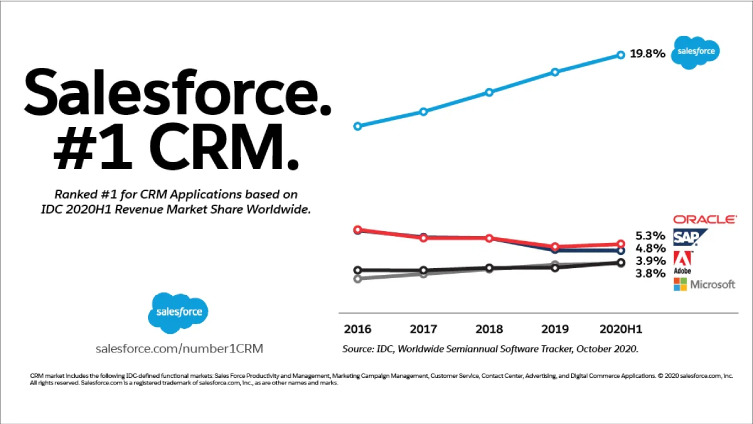
Salesforce’s SaaS model and continuous innovation have helped the company maintain its leadership in the CRM industry.
According to industry reports, Salesforce has held the position of the world’s #1 CRM provider for more than a decade. In 2023, the company captured about 21.7% of the global CRM market share, significantly ahead of many competitors.
- More than 150,000 businesses use Salesforce globally.
- A large percentage of Fortune 500 companies rely on Salesforce tools for customer management.
Businesses today rely on CRM platforms not only to store customer data but also to analyze customer behavior, personalize marketing campaigns, and improve customer experiences.
Continuous Innovation in the Salesforce Ecosystem
A key reason Salesforce remains the market leader is its commitment to innovation.
The company consistently introduces new technologies and features that help businesses manage customer relationships more effectively.
- AI-powered analytics for predicting customer behavior
- Automation tools that streamline repetitive tasks
- Data integration platforms that unify customer information
- Collaboration tools that connect teams across departments
As digital transformation continues across industries, CRM systems are becoming central to how organizations manage growth and customer engagement.
The Future of CRM and SaaS Platforms
The CRM industry continues to evolve as new technologies emerge.
Artificial intelligence, automation, and advanced data analytics are reshaping how companies interact with their customers. Modern CRM platforms are no longer just databases—they are intelligent systems that help businesses understand and anticipate customer needs.
The global CRM market is also expected to grow significantly over the next few years as more organizations adopt cloud-based software solutions.
Companies that leverage modern CRM systems will be better positioned to deliver personalized customer experiences, improve sales performance, and strengthen long-term relationships with their clients.
Salesforce’s early adoption of the SaaS model placed it at the center of this transformation, and its ongoing innovation continues to shape the future of customer relationship management.
Conclusion
Salesforce’s journey from a startup to the world’s leading CRM platform demonstrates how disruptive ideas can transform entire industries.
By introducing a cloud-based SaaS model, Salesforce eliminated many of the barriers that once prevented businesses from adopting advanced CRM systems. Its subscription model, cloud accessibility, and powerful ecosystem helped redefine how companies manage customer relationships.
Today, Salesforce is not just a CRM provider—it is a global platform that supports marketing, sales, customer service, analytics, and application development.
As businesses continue to prioritize customer experience and digital transformation, CRM platforms will remain essential tools for growth. Salesforce’s SaaS revolution has already reshaped the software industry, and its influence will likely continue to guide the future of customer relationship technology.
FAQs
Have questions? We’ve answered some of the most common queries to help you understand the topic better
Q1. What is Salesforce CRM?
Salesforce CRM is a cloud-based customer relationship management platform that helps businesses manage sales, marketing, customer support, and client data in one centralized system. It allows companies to track customer interactions and improve business relationships more efficiently.
Q2. Why is Salesforce considered the world’s #1 CRM?
Salesforce is considered the world’s #1 CRM because of its powerful cloud infrastructure, wide range of business tools, scalability, and strong ecosystem of integrations. It provides solutions for sales, marketing, customer service, analytics, and automation on a single platform.
Q3. What is the SaaS model used by Salesforce?
The SaaS (Software-as-a-Service) model used by Salesforce allows businesses to access CRM software through the internet instead of installing it on local servers. Companies pay a subscription fee and receive automatic updates, cloud storage, and easy scalability.
Q4. How does Salesforce help businesses improve customer relationships?
Salesforce helps businesses track customer data, manage sales pipelines, automate marketing campaigns, and provide better customer support. These features enable organizations to understand customer needs and deliver more personalized experiences.
Q5. Is Salesforce CRM suitable for small businesses?
Yes, Salesforce CRM is suitable for small businesses as well as large enterprises. Its cloud-based system offers flexible pricing plans, scalable features, and customizable tools that allow businesses to grow without changing their CRM platform.
Want To Grow Your Business - Connect With KTPL
KTPL – Business Growth Agency, a creative solutions and business growth agency from India.
👉 Visit https://kirnanitechnologies.com
📞 Call us at +91 95093 33000
📧 Email us at contact@kirnanitechnologies.com


