


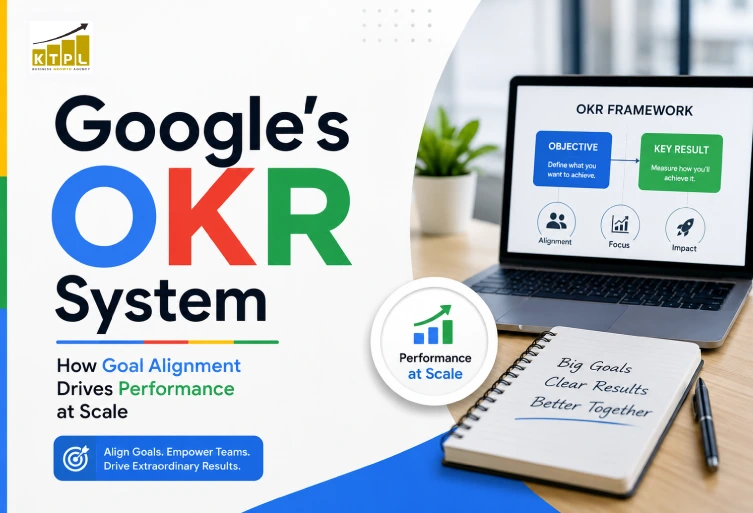
Modern businesses operate in highly competitive environments where teams must move quickly, collaborate efficiently, and remain aligned with organizational goals. As companies grow larger, maintaining clarity across departments becomes increasingly difficult. This is where Google’s OKR System has become one of the most influential performance management frameworks in the world. Google successfully uses OKRs to connect company vision with measurable execution, helping thousands of employees work toward shared outcomes without creating operational confusion.
The success of Google is not only driven by technology and innovation but also by the systems it uses internally to maintain focus and accountability. The OKR methodology enables employees, managers, and leadership teams to understand priorities clearly while encouraging ambitious thinking and continuous improvement. Unlike traditional corporate goal systems, Google’s framework supports flexibility, transparency, and innovation at every level of the organization.
Businesses across industries now study Google’s approach to goal alignment because it creates a balance between strategic direction and employee ownership. Whether a company is a startup, SaaS platform, digital agency, or enterprise organization, the principles behind Google’s OKR System can improve productivity, collaboration, and scalable growth.
What Is Google’s OKR System?
Google’s OKR System stands for Objectives and Key Results, a structured framework designed to help organizations define goals and measure progress effectively. The system creates a direct connection between company-wide priorities and individual employee contributions. Instead of employees working in isolated departments with unclear objectives, OKRs ensure that everyone understands what matters most and how success will be measured.
The framework focuses on two important components. Objectives describe the desired outcome or direction, while Key Results define measurable milestones used to evaluate progress. This combination allows organizations to maintain strategic clarity while promoting data-driven decision-making. Google uses this framework across all departments to maintain alignment between engineering, product development, marketing, operations, and leadership teams.
Unlike traditional annual performance systems that often become outdated quickly, Google’s OKR approach supports continuous adaptation and quarterly execution cycles. This flexibility allows teams to respond to market changes while staying connected to long-term organizational goals. The result is a scalable management structure capable of supporting rapid innovation and business expansion.
The History Behind Google’s OKR Framework
The foundation of Google’s OKR System can be traced back to Intel and management expert Andy Grove, who pioneered structured goal-setting practices for technology companies. Venture capitalist John Doerr later introduced the concept to Google’s founders during the company’s early growth stage. Since then, OKRs have become deeply integrated into Google’s operational culture and long-term strategy.
As Google evolved from a small startup into one of the world’s largest technology companies, maintaining organizational focus became increasingly challenging. The OKR framework provided a scalable solution that allowed leadership teams to communicate priorities clearly while encouraging employee autonomy and innovation. This system became essential for managing thousands of employees working on diverse projects simultaneously.
Today, many leading organizations including startups, SaaS companies, and multinational enterprises use similar OKR methodologies inspired by Google’s success. The framework has become widely recognized because it improves strategic execution without creating rigid bureaucratic structures. Businesses adopt Google’s OKR System to increase accountability, improve communication, and strengthen performance management across teams.
Understanding Objectives in Google’s OKR System
Objectives are the inspirational and qualitative component of the OKR framework. They define what a team or organization wants to achieve during a specific time period. At Google, objectives are intentionally ambitious because the company believes challenging goals drive innovation, creativity, and breakthrough thinking. Employees are encouraged to think beyond routine operational tasks and focus on meaningful business impact.
A strong objective is clear, concise, motivating, and aligned with broader organizational priorities. It should create direction without becoming overly detailed or restrictive. Google uses objectives to inspire teams while ensuring everyone understands the strategic purpose behind their work. This clarity helps reduce confusion and keeps departments aligned with company goals.
For example, an objective might focus on improving customer trust, expanding market reach, increasing product adoption, or enhancing platform performance. These objectives provide a sense of purpose while allowing teams flexibility in determining execution strategies. By emphasizing outcomes rather than rigid processes, Google’s OKR System encourages innovation and problem-solving throughout the organization.
Example of a Strong Objective
A strong objective within Google’s OKR framework could be:
“Improve user experience and customer satisfaction across digital products.”
This type of objective creates a clear direction while remaining broad enough to encourage creative thinking. It focuses on impact rather than daily tasks, allowing different teams to contribute through engineering improvements, customer support enhancements, design optimization, or performance upgrades. Employees understand the larger mission while maintaining flexibility in execution.
Google avoids weak objectives that focus only on routine activities because they fail to inspire teams or create strategic alignment. Instead, objectives are designed to push departments beyond their comfort zones and encourage continuous improvement. This ambitious mindset is one of the reasons why Google maintains strong innovation and rapid growth across multiple business areas.
Well-written objectives also improve collaboration because multiple departments can contribute toward shared outcomes. Marketing teams, developers, designers, and product managers can align their efforts around a common goal, reducing silos and improving operational efficiency.
Understanding Key Results in Google’s OKR System
Key Results are the measurable component of the OKR framework. They define how progress toward an objective will be tracked and evaluated. Unlike vague performance indicators, Key Results must be specific, numeric, time-bound, and verifiable. This ensures that success can be measured objectively rather than based on personal opinions or assumptions.
Google uses Key Results to create accountability and maintain focus across teams. Employees know exactly what metrics matter and how their performance contributes to larger organizational outcomes. This clarity improves decision-making because teams can prioritize activities that directly impact measurable goals.
Examples of Key Results include increasing customer retention rates, reducing technical errors, improving website speed, growing user engagement, or increasing organic traffic. Each result must have a clear metric attached to it so progress can be monitored consistently throughout the quarter or year.
Example of Effective Key Results
- Increase customer satisfaction score from 82% to 92%
- Reduce average support response time by 40%
- Improve onboarding completion rate by 30%
- Achieve 99.99% system uptime
These measurable indicators remove ambiguity and provide a clear roadmap for teams. Employees understand exactly what success looks like and can align daily activities with broader business goals. This structure is one of the main reasons why Google’s OKR System improves operational performance at scale.
Key Results also support transparency because progress can be tracked openly across departments. Managers can quickly identify challenges, allocate resources effectively, and adjust priorities when necessary.

How Google Uses Transparency for Goal Alignment
One of the most powerful features of Google’s OKR System is radical transparency. At Google, employee OKRs are visible across the organization, from senior leadership to entry-level employees. This open structure helps eliminate communication barriers and encourages stronger collaboration between teams.
Transparency allows employees to understand how their work contributes to company-wide priorities. It also helps departments identify overlapping projects, reduce duplicate efforts, and coordinate more effectively. Instead of isolated teams working independently, the organization operates with shared visibility and collective alignment.
This transparency also strengthens accountability because goals are openly visible to peers and leadership teams. Employees become more focused on measurable outcomes while managers gain better insight into organizational progress. Google believes that visibility improves trust, collaboration, and execution speed across large teams.
Benefits of Transparent OKRs
Transparent OKRs create several operational advantages for businesses. Teams can identify dependencies early, coordinate resources more efficiently, and solve cross-functional challenges faster. Employees also gain a better understanding of organizational strategy, which increases engagement and motivation.
Transparency reduces internal confusion because priorities are clearly documented and accessible. Departments avoid working toward conflicting goals, which improves efficiency and reduces wasted effort. This becomes especially important in large organizations where communication complexity increases as teams expand.
Another major advantage is cultural alignment. Open visibility creates a stronger sense of shared purpose across departments, helping employees feel connected to the company mission. This alignment is one of the reasons why Google successfully maintains innovation while operating at massive scale.
Why Google Encourages “Moonshot” Goals
Google’s OKR philosophy encourages teams to pursue ambitious stretch goals often referred to as “moonshots.” Instead of focusing only on safe and achievable targets, employees are encouraged to think bigger and pursue transformational outcomes. This mindset drives innovation and helps teams discover creative solutions to difficult challenges.
Google believes that aiming too low limits organizational potential. By setting aggressive objectives, employees become more willing to experiment, take calculated risks, and challenge traditional assumptions. This culture of ambitious thinking has contributed significantly to Google’s success across search, cloud computing, AI, advertising, and digital platforms.
Interestingly, Google does not expect teams to achieve 100% completion on every OKR. In fact, consistently reaching perfect scores may indicate that goals were not ambitious enough. The ideal achievement range is generally considered around 60% to 70%, reflecting challenging but meaningful progress.
The Importance of Stretch Goals
Stretch goals encourage innovation because employees feel empowered to explore unconventional ideas without fear of failure. When organizations reward only guaranteed success, teams often avoid experimentation and focus on low-risk activities. Google’s approach creates an environment where creativity and calculated risk-taking are valued.
This system also improves long-term business growth because ambitious goals often lead to breakthrough discoveries. Even if teams do not fully achieve every objective, the progress made can still generate significant improvements and learning opportunities.
By encouraging moonshot thinking, Google’s OKR System helps maintain a culture focused on continuous innovation rather than short-term comfort or routine operational performance.
Why Google Separates OKRs From Compensation
One of the most unique aspects of Google’s OKR System is the decision to separate OKR performance from employee bonuses and compensation. This approach prevents employees from setting overly safe goals simply to secure rewards or positive evaluations.
When compensation is directly linked to OKRs, employees may avoid ambitious objectives and focus only on targets they know they can achieve. Google intentionally avoids this behavior because it limits innovation and reduces organizational growth potential.
Instead, Google evaluates employee performance using broader criteria that include collaboration, problem-solving, leadership, and contribution quality. This allows OKRs to remain focused on ambitious growth and strategic experimentation.
How This Improves Performance Culture
Separating OKRs from compensation creates a healthier organizational culture. Employees feel more comfortable pursuing difficult goals because failure does not automatically result in financial penalties or negative evaluations. This encourages creativity, experimentation, and long-term thinking.
Teams become more honest about challenges and progress because they are not pressured to manipulate metrics for personal gain. Managers also gain more accurate insights into organizational performance, allowing better strategic decision-making.
This structure is one of the key reasons why Google’s OKR System supports innovation at scale while maintaining employee motivation and operational transparency.
Final Thoughts on Google’s OKR System
Google’s OKR System remains one of the most effective frameworks for aligning teams, improving accountability, and driving scalable business performance. By combining ambitious objectives with measurable Key Results, Google created a management system capable of supporting innovation across thousands of employees worldwide.
The framework succeeds because it balances strategic direction with employee autonomy. Teams understand organizational priorities while maintaining the flexibility needed for creative execution and problem-solving. Transparency, measurable progress tracking, and ambitious thinking all contribute to the long-term success of the system.
Businesses of all sizes can learn valuable lessons from Google’s approach to goal alignment. Whether managing a startup, digital agency, SaaS company, or enterprise organization, implementing structured OKRs can improve clarity, collaboration, and measurable growth in competitive markets.
FAQs
Have questions? We’ve answered some of the most common queries to help you understand the topic better
Q1. What does OKR stand for?
OKR stands for Objectives and Key Results, a framework used to define goals and measure progress.
Q2. Why is Google’s OKR System successful?
Google’s OKR System succeeds because it combines transparency, measurable goals, ambitious thinking, and employee ownership.
Q3. Are OKRs only for large companies?
No, startups and small businesses can also use OKRs to improve focus, accountability, and strategic alignment.
Q4. Does Google expect employees to achieve 100% of their OKRs?
No, Google considers 60%–70% achievement a healthy outcome for ambitious stretch goals.
Q5. Why are Google OKRs public internally?
Transparency improves collaboration, reduces silos, and helps employees align their work with company priorities.
Want To Grow Your Business - Connect With KTPL
KTPL – Business Growth Agency, a creative solutions and business growth agency from India.
👉 Visit https://kirnanitechnologies.com
📞 Call us at +91 95093 33000
📧 Email us at contact@kirnanitechnologies.com


