


Introduction
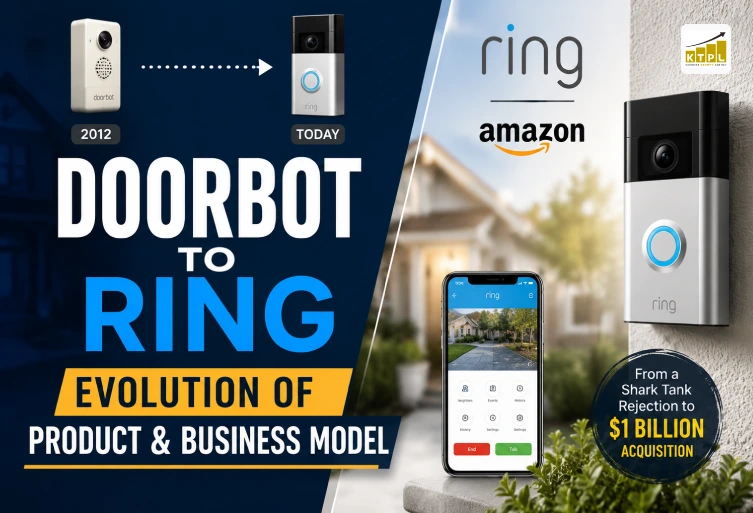
Every successful startup has a story filled with challenges, rejection, and unexpected opportunities. The journey from Doorbot to Ring is one of the best examples of how persistence, customer feedback, and strategic business decisions can transform a struggling product into a billion-dollar brand. Today, Ring is recognized as one of the world’s leading smart home security companies, but its journey began with a simple idea to make answering the front door easier through a smartphone. The Doorbot to Ring story became widely known after founder Jamie Siminoff appeared on Shark Tank US in 2013. Although none of the Sharks invested in his business, the national television exposure introduced millions of viewers to Doorbot. Instead of giving up after rejection, Siminoff used the attention to improve his product, refine his business strategy, and completely reposition the brand. Within just a few years, Doorbot evolved into Ring, expanded into an entire smart home security ecosystem, and was eventually acquired by Amazon for approximately $1 billion. What makes the Doorbot to Ring journey particularly fascinating is that the company didn’t simply redesign its hardware. It fundamentally transformed its business model from a one-time hardware purchase into a subscription-driven ecosystem that generated recurring revenue. This strategic shift helped Ring compete against established technology companies while building long-term customer relationships. For entrepreneurs, startup founders, and business professionals, the Doorbot to Ring case study demonstrates that a rejected investment pitch does not define a company’s future. Instead, continuous innovation, market adaptation, and customer-focused improvements often determine long-term success. This article explores how Doorbot became Ring, how its product evolved, and the business strategies that turned a simple smart doorbell into one of the most recognized names in home security.
What Was Doorbot?
Before Ring became a household name, the product was introduced as Doorbot, a smart video doorbell designed to let homeowners see and communicate with visitors using their smartphones. Jamie Siminoff originally developed Doorbot after facing a personal inconvenience in his garage workshop. Missing important deliveries because he couldn’t hear his traditional doorbell inspired him to create a connected solution that would work regardless of where the homeowner was located. Doorbot entered the market in 2012 with a vision that was ahead of its time. Internet-connected home devices were still relatively uncommon, and the concept of remotely answering a front door using a mobile application was considered highly innovative. The product featured a built-in camera, Wi-Fi connectivity, motion detection, and two-way audio, allowing homeowners to interact with visitors without physically opening the door. Despite introducing a unique solution, the first generation of Doorbot faced several technical limitations. The camera quality was average, battery performance required improvement, wireless connectivity could be inconsistent, and the overall industrial design lacked the premium appearance consumers expected for modern homes. These shortcomings affected customer experience and limited the product’s ability to compete with more polished consumer electronics. Another challenge was product positioning. Doorbot was marketed primarily as a convenient video doorbell rather than a comprehensive home security solution. While convenience attracted early adopters, it wasn’t compelling enough for mass-market adoption. Customers often viewed the product as a useful gadget rather than an essential security investment, making long-term business growth more difficult. Even with these obstacles, Doorbot successfully demonstrated that there was genuine demand for smart home technology. The company gathered valuable customer feedback, learned how users interacted with connected devices, and identified opportunities for product improvement. These early lessons became the foundation for Ring’s future success and played a critical role in the Doorbot to Ring transformation. Most importantly, Doorbot proved that innovation does not have to begin with a perfect product. Many successful technology companies launch with imperfect solutions and improve them based on real-world customer experiences. Doorbot’s initial shortcomings ultimately became valuable learning opportunities that shaped Ring’s future product strategy.
Doorbot's Shark Tank Journey
In 2013, Jamie Siminoff appeared on Shark Tank US hoping to secure investment for Doorbot. He entered the show seeking $700,000 in exchange for a 10% equity stake, valuing the company at approximately $7 million. At the time, this valuation appeared ambitious for a startup that was still refining its product and generating limited revenue. During his presentation, Siminoff explained how Doorbot allowed homeowners to answer their doors remotely using a smartphone. He demonstrated the technology and emphasized the growing importance of connected home devices. While the concept impressed the Sharks, many questioned whether consumers would be willing to pay a premium price for what they perceived as a convenience product rather than a necessity. The Sharks also expressed concerns about manufacturing costs, customer acquisition expenses, scalability, and competitive threats from larger technology companies. Some investors believed that hardware businesses typically required significant capital while generating relatively low profit margins. Others questioned whether Doorbot had enough differentiation to maintain a sustainable competitive advantage in the rapidly evolving consumer electronics industry. Although Jamie Siminoff answered many questions confidently and demonstrated his passion for the business, none of the Sharks decided to invest. From a television perspective, it appeared to be another startup leaving the stage without funding. However, the public exposure proved far more valuable than anyone expected. Millions of viewers became aware of Doorbot almost overnight. Following the Shark Tank episode, Doorbot experienced a dramatic increase in website traffic, customer interest, and product sales. Consumers who watched the show searched for the company online, visited its website, and began purchasing the smart doorbell. The nationwide visibility created by the television appearance effectively served as a large-scale marketing campaign without the enormous advertising costs that a startup would normally face. The Doorbot to Ring story highlights an important entrepreneurial lesson: rejection from investors does not necessarily indicate a weak business. Sometimes the exposure, customer validation, and market awareness generated by a high-profile opportunity can become even more valuable than the investment itself. Jamie Siminoff recognized this opportunity and used the momentum to rethink both his product strategy and long-term business vision.
Why Rebranding from Doorbot to Ring Changed Everything
The growing popularity after Shark Tank encouraged Jamie Siminoff to think beyond a single smart doorbell. Rather than continuing to position Doorbot as a standalone gadget, he recognized that homeowners were increasingly interested in complete home security solutions. This realization led to one of the most important strategic decisions in the company’s history—the transformation from Doorbot to Ring. The rebranding was far more significant than changing a company name or redesigning the product packaging. The name “Ring” represented a broader mission of creating a protective “ring of security” around every home. This emotional positioning helped customers associate the brand with family safety, neighborhood protection, and peace of mind rather than simply answering the front door remotely. Along with the new identity came major product improvements. The redesigned Ring Video Doorbell featured better camera resolution, enhanced motion detection, improved mobile connectivity, higher-quality audio, and a more attractive design that blended naturally with modern homes. These upgrades significantly improved customer satisfaction and reduced many of the technical complaints associated with the original Doorbot. The company’s marketing strategy also changed dramatically. Instead of promoting technical specifications alone, Ring focused on real-life stories involving package theft prevention, home security, visitor identification, and neighborhood awareness. This emotional storytelling helped customers understand the practical value of the product, making it easier to justify the purchase as an investment in safety rather than another smart gadget. The Doorbot to Ring transformation also established a stronger brand identity capable of supporting future product expansion. A name like Doorbot limited the company’s identity to doorbells, whereas Ring could naturally extend into cameras, alarms, lighting, sensors, and other smart home security devices. This strategic flexibility would later become one of the company’s greatest competitive advantages. By successfully repositioning its brand, improving its technology, and aligning its messaging with customer priorities, Ring laid the foundation for rapid growth in the smart home security market. The evolution from Doorbot to Ring demonstrated that successful startups often grow by redefining not only what they sell but also the value they deliver to customers.

How Community Building Fueled the Early Growth of Nootrobox (HVMN)
One of the biggest reasons behind the success of Doorbot to Ring was not just the improvement in the product but the transformation of its business model. In its early days, Doorbot relied almost entirely on one-time hardware sales. Customers paid approximately $199 for the smart doorbell, and once the purchase was complete, the company’s relationship with the customer was largely over. While this model generated revenue, it also meant that future growth depended on continuously acquiring new buyers, which required substantial marketing and distribution costs. As the company evolved into Ring, Jamie Siminoff realized that hardware alone would never provide predictable long-term income. The consumer electronics industry is highly competitive, and relying solely on product sales often leads to fluctuating revenue and shrinking profit margins. Instead of viewing the doorbell as the final product, Ring positioned it as the entry point to an ongoing home security service. This strategic shift completely changed how the company generated value for both customers and investors. Ring introduced Ring Protect, a subscription-based service that allowed users to store recorded videos in the cloud, review past events, share footage with family members, and access advanced monitoring features. Customers who wanted more than live video were encouraged to subscribe for a small monthly fee. This recurring revenue model transformed Ring from a hardware manufacturer into a technology company with Software-as-a-Service (SaaS)-like characteristics. The subscription strategy also improved customer retention. Instead of interacting with the brand only when purchasing a new device, subscribers continued using Ring’s services every day. Cloud video storage, motion alerts, event history, and additional security features created an ongoing relationship between the customer and the company. This increased customer lifetime value while reducing dependence on constant hardware upgrades. Another advantage of recurring revenue was financial stability. Investors often value companies with predictable monthly income higher than businesses relying only on one-time sales. Ring’s subscription model created a steady cash flow that could be reinvested into research, product development, marketing, and international expansion. This financial strength allowed the company to compete effectively with much larger technology brands. The Doorbot to Ring business model demonstrates one of the most important lessons for modern startups: successful companies often combine high-quality products with recurring services. Instead of treating a product as the end of the customer journey, Ring created an ecosystem that encouraged long-term engagement. This approach significantly increased the company’s valuation and played a major role in attracting Amazon’s interest.
Building a Complete Smart Home Security Ecosystem
After successfully rebranding, Ring understood that sustainable growth required more than a single flagship product. While the Ring Video Doorbell remained the company’s most recognizable device, customer needs extended far beyond the front door. Homeowners wanted complete visibility around their property, and Ring responded by gradually expanding its portfolio into a comprehensive smart home security ecosystem. The company introduced a range of products, including indoor cameras, outdoor security cameras, floodlight cameras, spotlight cameras, alarm systems, peephole cameras, and smart lighting solutions. Each device was designed to integrate seamlessly with the Ring mobile application, allowing users to manage their entire home security system from a single platform. This ecosystem approach increased customer convenience while encouraging additional purchases. One of Ring’s most innovative additions was the Neighbors app, which allowed users to share local crime alerts, suspicious activity, and security footage with nearby residents. Rather than functioning solely as a product feature, the platform created a sense of community participation. Homeowners became active contributors to neighborhood safety, strengthening customer engagement and reinforcing Ring’s brand identity. Integration with voice assistants also accelerated adoption. Compatibility with Amazon Alexa and Echo devices enabled users to receive real-time notifications, answer the door through smart displays, and monitor security cameras using voice commands. This connected experience aligned perfectly with the growing smart home market and made Ring a central component of many connected households. Expanding the product ecosystem also strengthened customer loyalty. A homeowner who purchased multiple Ring devices became far less likely to switch to another brand because replacing an entire integrated system would require significant cost and effort. This increased switching cost became another competitive advantage that supported long-term business growth. The evolution from a single video doorbell to a complete smart home ecosystem highlights why the Doorbot to Ring journey is frequently studied as a business transformation case. Instead of chasing short-term hardware sales, Ring focused on creating a connected experience that generated lasting customer relationships and multiple revenue opportunities.
Amazon's Billion-Dollar Acquisition and Global Expansion
By 2018, Ring had established itself as one of the fastest-growing companies in the smart home security industry. Strong hardware sales, recurring subscription revenue, and a rapidly expanding customer base attracted the attention of major technology companies looking to strengthen their positions in the connected home market. Among them, Amazon recognized that Ring perfectly complemented its broader smart home strategy. Amazon acquired Ring for an estimated $1 billion, making it one of the most successful startup exits associated with a Shark Tank entrepreneur. Although Jamie Siminoff had once left the Shark Tank stage without an investment, he ultimately built a company whose value far exceeded the offers typically made on the show. The acquisition became one of the strongest examples of perseverance leading to extraordinary business success. Joining Amazon provided Ring with significant advantages. The company gained access to Amazon’s global supply chain, logistics network, cloud infrastructure through AWS, and worldwide customer reach. These resources enabled Ring to scale production, improve operational efficiency, and expand into new international markets much faster than would have been possible as an independent company. The acquisition also strengthened Ring’s integration with Amazon’s ecosystem. Products became deeply connected with Alexa-enabled devices, Echo smart speakers, and Fire TV products, creating a seamless smart home experience for consumers. Cross-platform compatibility increased product visibility and encouraged customers already using Amazon devices to adopt Ring’s security solutions. Although becoming part of Amazon accelerated growth, Ring continued investing in innovation by improving artificial intelligence, motion detection, cloud security, and device reliability. The company expanded its product lineup while maintaining its mission of making neighborhoods safer through connected technology. Continuous innovation helped Ring remain competitive despite increasing competition in the smart home industry. The Doorbot to Ring acquisition demonstrates how startups can dramatically increase their value by solving real customer problems, creating scalable business models, and building strong ecosystems. Rather than focusing solely on short-term profitability, Ring developed strategic assets that made the company highly attractive to one of the world’s largest technology corporations.
Business Lessons Entrepreneurs Can Learn from Doorbot to Ring
The transformation from Doorbot to Ring offers valuable lessons for entrepreneurs, startup founders, and business leaders. Perhaps the most important lesson is that rejection does not determine success. Jamie Siminoff was turned down by every Shark on national television, yet he continued improving his business instead of abandoning his vision. Persistence, combined with continuous learning, ultimately proved more valuable than immediate investment. Another important lesson is the importance of listening to customers. Instead of defending every aspect of the original Doorbot product, the company carefully analyzed customer feedback and identified areas requiring improvement. Better design, stronger performance, improved reliability, and enhanced user experience all resulted from understanding what customers truly wanted rather than assuming the first version was perfect. The Doorbot to Ring story also highlights the value of strategic positioning. Consumers were more likely to invest in home security than in a convenience gadget. By changing the brand message from remote door answering to neighborhood safety, Ring connected with customers on an emotional level. Strong branding often influences purchasing decisions as much as technological innovation. Recurring revenue is another major takeaway. Many startups concentrate entirely on selling products, but Ring demonstrated how subscription services can improve financial stability and customer retention. Building predictable monthly income creates stronger cash flow, increases company valuation, and supports long-term growth without depending exclusively on new customer acquisition. Entrepreneurs should also recognize the importance of building ecosystems rather than isolated products. Customers increasingly prefer connected experiences where multiple devices and services work together seamlessly. Expanding beyond a single product enabled Ring to increase customer lifetime value while strengthening brand loyalty and competitive differentiation. Finally, the Doorbot to Ring journey reminds every entrepreneur that success is rarely immediate. Great businesses evolve through experimentation, customer feedback, strategic pivots, and continuous innovation. The willingness to improve both the product and the business model often separates companies that disappear from those that redefine entire industries.
Conclusion
The evolution of Doorbot to Ring is far more than a Shark Tank success story—it is a powerful example of how innovation, resilience, and strategic thinking can transform a startup into a global technology brand. What began as a simple smart doorbell addressing a personal inconvenience eventually became one of the world’s most recognized home security platforms. Through product improvements, customer-focused innovation, subscription-based revenue, ecosystem expansion, and a billion-dollar acquisition by Amazon, Ring proved that sustainable growth comes from continuously adapting to market needs. For entrepreneurs, the journey reinforces that rejection should never be viewed as the end of an idea. Instead, it can become the motivation to refine a product, rethink a business model, and discover new opportunities for growth. The Doorbot to Ring transformation continues to inspire founders around the world because it demonstrates that solving genuine customer problems, embracing innovation, and building recurring value can create extraordinary business success.
FAQs
Have questions? We’ve answered some of the most common queries to help you understand the topic better.
Q1. What was Doorbot?
Doorbot was the original smart video doorbell created by Jamie Siminoff in 2012, allowing homeowners to see and communicate with visitors through a smartphone.
Q2. Why did Doorbot become Ring?
The company rebranded to Ring in 2014 to position itself as a complete home security brand instead of a single smart doorbell product.
Q3. Did Doorbot receive funding on Shark Tank?
No. Jamie Siminoff pitched Doorbot on Shark Tank US in 2013, but none of the Sharks invested in the company.
Q4. Why is the Doorbot to Ring story considered a business success?
The company successfully evolved from a hardware startup into a subscription-driven smart home security ecosystem before being acquired by Amazon for approximately $1 billion.
Q5. What is Ring Protect?
Ring Protect is Ring’s subscription service that provides cloud video storage, event history, video sharing, and additional security features through recurring monthly or annual plans.
Want To Grow Your Business - Connect With KTPL
KTPL – Business Growth Agency, a creative solutions and business growth agency from India.
👉 Visit https://kirnanitechnologies.com
📞 Call us at +91 95093 33000
📧 Email us at contact@kirnanitechnologies.com


