


In the startup ecosystem, one of the most critical decisions entrepreneurs face is choosing between licensing their product or manufacturing it themselves. This decision directly impacts growth, scalability, profitability, and long-term brand value. Shows like Shark Tank and Shark Tank India have brought this discussion into the spotlight by showcasing real-world business models and investor decisions.
Many founders enter these platforms with innovative ideas but struggle to decide the best way to scale them. Some choose to build full-fledged companies with their own production units, while others prefer partnering with established brands through licensing agreements. Both paths have proven successful, but they require different mindsets, resources, and execution strategies.
Understanding these two approaches deeply is essential for entrepreneurs who want to minimize risks and maximize growth. This blog explores licensing and manufacturing in detail, backed by Shark Tank brand comparisons, practical insights, and strategic takeaways for modern startups.
Understanding Licensing vs Manufacturing
Licensing and manufacturing are two completely different approaches to building and scaling a business, and each comes with its own set of advantages and challenges. While manufacturing focuses on building a brand from the ground up, licensing emphasizes leveraging existing infrastructure for faster expansion. Entrepreneurs must evaluate their resources, long-term vision, and risk tolerance before choosing between these paths.
In the context of Shark Tank, investors often assess whether a founder is capable of handling manufacturing complexities or if licensing would be a smarter route. This decision can determine how quickly a product reaches the market and how much control the founder retains. Both strategies require strong intellectual property protection to ensure long-term sustainability.
Choosing the right path is not just about profits; it’s about aligning your business model with your personal goals and operational capabilities. Let’s break down each model to understand them better.
What is Manufacturing?
Manufacturing refers to the process where a company produces its own products, manages supply chains, and sells directly to customers or businesses. This model requires founders to take full responsibility for production quality, inventory management, and logistics. It also involves building a strong brand identity that connects with customers over time.
In this approach, entrepreneurs invest heavily in product development and infrastructure, which allows them to maintain complete control over their business operations. This control helps in creating a unique brand presence and delivering consistent customer experiences. However, it also increases the complexity of running the business.
Successful examples like Scrub Daddy and Bombas demonstrate how manufacturing-focused strategies can lead to massive success when executed properly. These brands focused on quality, innovation, and strong marketing to build loyal customer bases.
Manufacturing is ideal for entrepreneurs who want to create a long-lasting brand and are ready to handle operational challenges. It offers higher profit margins but requires patience, capital, and strategic execution to succeed in competitive markets.
What is Licensing?
Licensing is a business model where the product owner allows another company to manufacture, distribute, and sell their product in exchange for a royalty fee. This approach eliminates the need for setting up factories or managing supply chains, making it a more accessible option for many inventors.
In licensing, the primary focus is on developing a strong idea or product and securing intellectual property rights such as patents or trademarks. Once the IP is protected, the inventor can partner with established companies that already have the infrastructure to scale the product quickly.
This model is commonly seen on Shark Tank, where some entrepreneurs prefer to monetize their ideas without getting involved in day-to-day operations. Licensing allows them to focus on innovation while leveraging the partner’s expertise in manufacturing and distribution.
Although licensing reduces operational burden, it also means giving up a certain level of control over branding and product execution. However, for many entrepreneurs, the trade-off is worth it due to faster market entry and reduced financial risk.
Key Differences Between Licensing and Manufacturing
The core difference between licensing and manufacturing lies in control, risk, and scalability. While manufacturing gives full ownership of the business, licensing shifts operational responsibilities to a third party. Understanding these differences helps entrepreneurs choose the right strategy based on their goals.
Manufacturing requires significant investment and hands-on management, making it suitable for founders who want to build a strong brand identity. Licensing, on the other hand, offers a simpler route by allowing entrepreneurs to earn royalties without managing operations.
Both approaches have their own profit structures, risk levels, and growth potential. The right choice depends on whether you prioritize control and long-term value or speed and convenience. Let’s explore specific aspects in more detail.
Control vs Convenience
Manufacturing gives founders complete control over every aspect of the business, from product design to customer experience. This level of control allows for better brand positioning and long-term growth. However, it also requires continuous involvement in operations and decision-making.
Licensing offers convenience by transferring operational responsibilities to a partner company. This allows entrepreneurs to focus on innovation rather than execution. However, the trade-off is reduced control over how the product is marketed and sold.
Entrepreneurs must decide whether they value independence or ease of execution. Control can lead to higher rewards, but convenience can provide faster results with less effort.
Risk vs Stability
Manufacturing involves higher risks due to upfront investments in production, inventory, and logistics. Market fluctuations and demand uncertainty can also impact profitability. This makes it a challenging option for startups with limited resources.
Licensing provides more stability as it minimizes financial exposure. Since the partner company handles production and distribution, the inventor faces lower operational risks. This makes licensing an attractive option for risk-averse entrepreneurs.
However, stability comes at the cost of reduced earnings potential. Entrepreneurs must balance risk and reward when choosing their strategy.
Profit Potential
Manufacturing offers higher profit margins because the company retains full ownership of the product and brand. Over time, this can lead to significant wealth creation and high company valuations.
Licensing generates income through royalties, which typically range between 1% and 15%. While this provides a steady income stream, it limits overall earning potential compared to manufacturing.
The choice between these models depends on whether you prefer long-term wealth creation or consistent passive income.
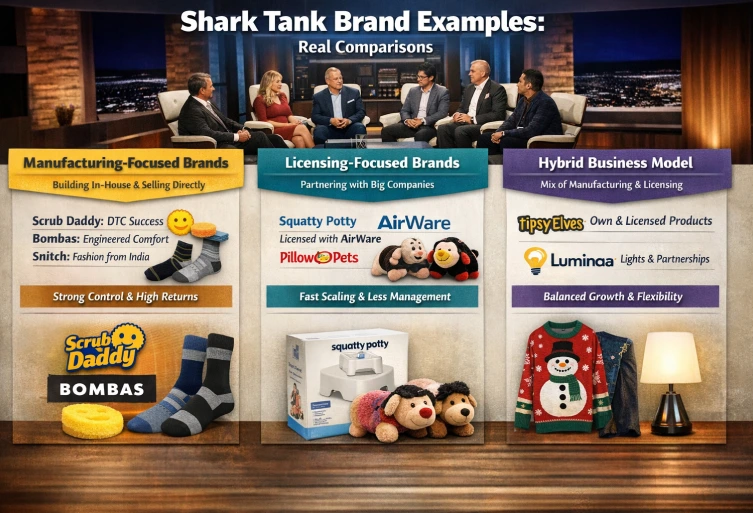
Shark Tank Brand Examples: Real Comparisons
Real-world examples from Shark Tank provide valuable insights into how licensing and manufacturing strategies work in practice. These examples highlight the strengths and weaknesses of each approach and help entrepreneurs understand what works best in different scenarios.
By analyzing successful brands, we can identify patterns and strategies that contribute to their growth. Whether it’s building a strong D2C brand or leveraging licensing deals, these case studies offer practical lessons for startups.
Let’s explore different categories of brands and their strategies.
Manufacturing-Focused Brands
Brands like Scrub Daddy and Bombas focused on building their own manufacturing systems and scaling through direct-to-consumer strategies. They invested heavily in product quality and branding, which helped them stand out in competitive markets.
In India, Snitch is a great example of a brand that scaled successfully by controlling its production and shifting to a D2C model. This approach allowed them to build a strong identity and achieve high valuation.
Manufacturing-focused brands require strong operational capabilities, but they offer long-term growth and higher returns. These brands often become household names due to their consistent quality and branding efforts.
Licensing-Focused Brands
Many inventors on Shark Tank prefer licensing their products to established companies. This allows them to scale quickly without investing in infrastructure or managing operations.
Licensing-focused brands benefit from the partner’s existing distribution networks and market presence. This leads to faster adoption and reduced time to market.
However, these brands depend heavily on the licensee’s performance, which can impact overall success. Despite this, licensing remains a popular choice for inventors who prioritize simplicity and speed.
Hybrid Business Model
The hybrid model combines manufacturing and licensing to create a balanced growth strategy. Companies manufacture their core products while licensing certain categories to external partners.
This approach allows businesses to maintain brand control while expanding into new markets quickly. It also helps in reducing risks associated with full-scale manufacturing.
Hybrid models are becoming increasingly popular as they offer flexibility and scalability. They provide the best of both worlds for modern entrepreneurs.
Insights from Shark Tank India
Shark Tank India has provided valuable insights into the Indian startup ecosystem. It highlights the importance of scalability, compliance, and strong business fundamentals.
Many startups fail not because of bad ideas but due to poor execution and lack of structure. Investors on the show emphasize the need for clarity in business models and growth strategies.
These insights can help entrepreneurs avoid common mistakes and build successful businesses.
Compliance and Structuring Matter
Startups must focus on legal and financial structuring to attract investors and scale effectively. Proper compliance ensures smooth operations and builds trust with stakeholders.
Without a strong foundation, even innovative ideas struggle to succeed. Entrepreneurs must prioritize documentation, taxation, and corporate governance.
This is a key factor that separates successful startups from unsuccessful ones.
White-Label vs Proprietary Products
Many startups rely on white-label manufacturing to launch products quickly. While this reduces costs and speeds up production, it limits differentiation.
Proprietary products with strong IP offer better long-term growth and brand value. Investors often prefer businesses that own their products rather than relying on generic manufacturing.
Choosing between these approaches depends on your business goals and resources.
Speed to Market is Critical
In today’s competitive environment, speed is a major factor in success. Licensing or partnerships can help startups launch products quickly and capture market share.
Delays in product launch can lead to missed opportunities and increased competition. Entrepreneurs must focus on execution speed without compromising quality.
This is one of the most important lessons from Shark Tank India.
Final Thoughts
Licensing and manufacturing are both powerful strategies, but they cater to different types of entrepreneurs and business goals. Manufacturing is ideal for those who want to build a long-term brand and are willing to handle operational complexities. Licensing is better suited for those who prefer simplicity and faster market entry.
There is no one-size-fits-all solution, and the right choice depends on your vision, resources, and risk appetite. By learning from Shark Tank examples, entrepreneurs can make informed decisions and build successful businesses.
Ultimately, success lies in execution, innovation, and the ability to adapt to changing market conditions.
FAQs
Have questions? We’ve answered some of the most common queries to help you understand the topic better
Q1. What is better: licensing or manufacturing?
Both are effective strategies, but manufacturing offers higher profits while licensing provides lower risk and faster scalability.
Q2. Can I switch from licensing to manufacturing later?
Yes, many businesses start with licensing and later move to manufacturing as they grow.
Q3. Is licensing suitable for beginners?
Yes, it is ideal for beginners due to its low investment and operational simplicity.
Q4. Why is IP important in licensing?
IP protects your idea and ensures you earn royalties legally.
Q5. What do investors prefer on Shark Tank?
Investors prefer scalable businesses with strong IP and clear growth strategies.
Want To Grow Your Business - Connect With KTPL
KTPL – Business Growth Agency, a creative solutions and business growth agency from India.
👉 Visit https://kirnanitechnologies.com
📞 Call us at +91 95093 33000
📧 Email us at contact@kirnanitechnologies.com


