


Introduction
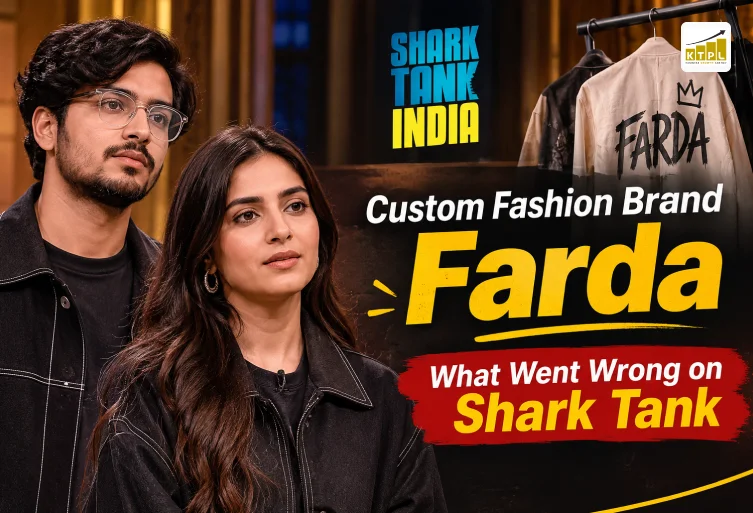
The Indian fashion industry is changing rapidly as customers increasingly look for clothing that reflects their personality, creativity, and individual style. Traditional fashion brands generally focus on ready-made collections, but the growing popularity of streetwear has created opportunities for businesses offering exclusive designs and personalised clothing. One such business that attracted national attention was Custom Fashion Brand Farda, an Indian streetwear startup founded by Chahat Pahuja and Sanskar Mishra. The brand initially focused on customised clothing, including hand-painted jeans, jackets, and T-shirts, giving customers an opportunity to wear something different from ordinary mass-produced fashion. Farda became widely recognised after appearing on Shark Tank India Season 1, where its founders presented their creative business idea to experienced investors. Their pitch attracted the attention of Aman Gupta and Namita Thapar, who offered ₹30 lakh for 20% equity, valuing the company at ₹1.5 crore. Although the founders accepted the offer on television, the investment did not eventually close after the post-show due diligence process. This raised questions about the business model, production capacity, sales performance, and the company’s ability to grow. However, the story did not end there. Instead of giving up, the founders continued developing their fashion business and gradually moved towards a broader streetwear identity. The journey of Custom Fashion Brand Farda offers valuable lessons about entrepreneurship, brand positioning, scalability, and the challenges of turning a creative idea into a sustainable business.
What Is Custom Fashion Brand Farda and How Did It Start?
Farda is an Indian streetwear label founded in 2021 by Chahat Pahuja and Sanskar Mishra, with its roots in Nagpur, Maharashtra. The founders wanted to create a fashion brand that combined clothing with artistic expression, allowing customers to wear designs that represented their personal interests and individuality. Instead of following the traditional clothing business model of manufacturing large quantities of identical products, Farda initially concentrated on customised garments featuring hand-painted artwork and creative detailing. Its early product range included personalised jeans, T-shirts, jackets, and other streetwear pieces that attracted customers looking for exclusive fashion. According to the brand’s official story, its philosophy revolves around art, culture, individuality, and creating clothing that makes a statement. The business reportedly started with an initial investment of approximately ₹35,000, making it a relatively small entrepreneurial venture. Instagram played an important role in its early development because the founders could showcase their designs, communicate directly with customers, and receive orders without investing heavily in physical retail infrastructure. Their first flea-market pop-up in Nagpur reportedly generated around ₹33,000 in sales, giving them an early indication that customers were interested in customised streetwear. As the business developed, the founders recognised that their creative concept could potentially become a recognised fashion label rather than remain a small customised clothing operation. This ambition eventually brought them to Shark Tank India, where they received an opportunity to present their business to experienced investors.
What Happened During Farda's Shark Tank India Pitch?
When Chahat Pahuja and Sanskar Mishra appeared on Shark Tank India Season 1, they introduced Farda as a customised streetwear business focused on artistic designs and personalised clothing. Their presentation highlighted how the brand was different from conventional fashion labels because customers could purchase clothing that offered a more individual and creative experience. During the pitch, the founders reportedly shared that the company had generated approximately ₹1.3 lakh in total sales over its initial four months. Although this demonstrated some early customer interest, it also showed that the business was still at a very early stage and had limited commercial experience. The founders initially asked for ₹30 lakh in exchange for 10% equity, implying a valuation of ₹3 crore. After discussions and negotiations, Aman Gupta and Namita Thapar offered ₹30 lakh for 20% equity, bringing the proposed valuation to ₹1.5 crore. The founders accepted the offer, making it an exciting moment in their entrepreneurial journey. However, the sharks were interested in more than the artistic appearance of the products. They wanted to understand how the company would manage production, control costs, maintain quality, and increase sales as customer demand grew. The pitch therefore highlighted an important difference between having a creative product and building a business capable of operating at a much larger scale.
Why Did the Sharks Raise Concerns and Why Did the Deal Not Close?
The main concern surrounding Custom Fashion Brand Farda was its ability to scale a business that depended heavily on handmade customisation. Hand-painted clothing requires time, artistic skills, individual attention, and careful finishing, making it more complicated to manufacture than standard ready-made garments. If orders increased significantly, the founders would need more skilled workers, better production planning, and quality-control systems to maintain the same product standards. The company’s early sales of approximately ₹1.3 lakh over four months also raised questions about whether it had established enough customer demand to justify its proposed valuation. Another consideration was its premium pricing, with reports mentioning jeans priced around ₹2,800 and jackets around ₹3,500. Customers paying these prices expect good fabric quality, attractive artwork, durability, and a reliable shopping experience, which can be challenging for a new fashion label without a well-established reputation. The founders’ young age also became part of the discussion, but the more important concern was their experience in handling production, supply chains, financial management, and business expansion. These are essential responsibilities for any startup that wants to grow beyond its initial customer base. Although the founders accepted the ₹30 lakh investment offer on television, the agreement did not eventually close after the post-show due diligence process, according to follow-up reports. Due diligence generally involves examining company documents, financial records, ownership details, legal arrangements, and other important business information before an investment is finalised. However, publicly available reports do not establish one definitive reason for why Farda’s deal fell through. It would therefore be inaccurate to attribute the outcome to a specific financial or legal problem without confirmed evidence. The experience demonstrates that a televised handshake is not the same as a completed investment transaction.
How Did Farda Grow and Change Its Business Model After Shark Tank?
Although the investment did not close, Farda benefited from the national visibility it received through Shark Tank India. Before appearing on the show, the company primarily depended on Instagram, customer recommendations, and smaller marketing activities to introduce its products. Its television appearance allowed thousands of viewers to discover the founders, understand their creative concept, and explore their customised clothing. According to post-show accounts reported by Shark Tank India Club, Farda’s Instagram following increased to approximately 55,000 within around 20 days of the episode’s exposure. This sudden attention created opportunities to reach new customers, receive enquiries, and increase brand recognition without depending entirely on paid advertising. For an emerging direct-to-consumer fashion business, such visibility can be valuable because customers often discover independent clothing labels through social media and online recommendations. However, the founders still needed to convert that attention into actual sales and long-term customer relationships.One of the most important developments was Farda’s shift from relying mainly on individual customised orders towards becoming a more design-led streetwear label. In a later interview with Startup Pedia, co-founder Chahat Pahuja discussed the founders’ ambition to build a brand that went beyond customised clothing and focused more strongly on artistic fashion. The company gradually developed a broader product range that included jackets, cargos, lowers, co-ord sets, T-shirts, and accessories. Its collections focused on exclusive designs, creative expression, and statement pieces rather than simply offering personalisation for every order. This approach gave Farda more opportunities to establish a recognisable visual identity while developing a business model suited to a wider fashion audience. The brand also developed online direct-to-consumer sales alongside offline retail opportunities, helping customers discover its collections through different shopping channels. A later Startup Pedia interview reported approximately ₹10 lakh in monthly revenue during FY25, although this should be treated as a historical media-reported figure rather than verified current revenue. The most significant development was not simply the reported financial performance but the founders’ ability to continue operating and refine their original business concept. Their journey shows that a business can change its product strategy without completely abandoning the creative idea that made it different in the first place.
Business Lessons Entrepreneurs Can Learn From Farda
The journey of Custom Fashion Brand Farda offers several important lessons for entrepreneurs planning to build a fashion brand, creative business, or direct-to-consumer startup. First, a unique product needs a scalable business model because creativity alone cannot manage increasing orders, production expenses, and delivery requirements. Businesses should understand their production capacity and operational limitations before investing heavily in marketing or expansion. Second, early sales are important because they help founders understand whether customers are genuinely willing to pay for their products. Instead of focusing only on social media followers, entrepreneurs should measure actual purchases, repeat customers, customer feedback, and revenue growth. Third, pricing should communicate the value of a product through its quality, materials, craftsmanship, and customer experience, especially when a brand positions itself in the premium fashion segment. Another important lesson is the value of a strong brand identity. Customers should understand what makes a business different and why they should choose it over competing products. Farda’s evolution demonstrates how exclusive collections and consistent design direction can help a brand develop a more recognisable position in the market. Entrepreneurs should also treat digital marketing as a business-growth tool rather than simply a way to increase followers. A well-designed website, useful product information, engaging content, and reliable customer service can help convert online visitors into paying customers. Finally, founders must remain flexible because the business model that works during the early stages may not be suitable for long-term growth. Farda’s experience shows that setbacks, including an investment deal that does not close, can become opportunities to reassess business decisions and develop a stronger direction.
Conclusion: What Really Went Wrong With Farda on Shark Tank?
The story of Custom Fashion Brand Farda is not simply about a Shark Tank investment deal that failed to close; it is about two young founders who entered the fashion industry with a creative concept and continued developing their business despite early challenges. The sharks’ concerns were mainly connected to limited sales, handmade production, premium pricing, and the difficulty of scaling a customised clothing business. Although Chahat Pahuja and Sanskar Mishra accepted an on-air offer of ₹30 lakh for 20% equity from Aman Gupta and Namita Thapar, the investment reportedly did not get finalised after due diligence. Instead of allowing this setback to stop their journey, the founders continued building Farda and developed a broader identity around exclusive streetwear, artistic designs, and contemporary fashion. Their experience demonstrates that building a successful brand requires more than an attractive product or a memorable television appearance. For entrepreneurs, the biggest lesson is that a creative idea needs strong business planning, customer understanding, efficient operations, and a clear digital presence to become sustainable. Brands must continuously improve their products, communicate their value, and develop meaningful relationships with their customers. At KTPL – Business Growth Agency, we understand how branding, website design, SEO, and content marketing contribute to building a recognisable business in a competitive market. Farda’s journey is a reminder that business growth is not always a straight path and that the ability to adapt, learn, and make informed decisions can be just as important as the original idea.
FAQs
Have questions? We’ve answered some of the most common queries to help you understand the topic better.
Q1. What is Custom Fashion Brand Farda?
Farda is an Indian streetwear brand founded by Chahat Pahuja and Sanskar Mishra, initially known for customised and hand-painted clothing.
Q2. Who invested in Farda on Shark Tank India?
Aman Gupta and Namita Thapar offered ₹30 lakh for 20% equity during Season 1.
Q3. Why did Farda's Shark Tank deal not close?
The investment reportedly did not get finalised after post-show due diligence. The definitive reason has not been publicly established.
Q4. What happened to Farda after Shark Tank?
The founders continued the business and developed it into a broader, design-led streetwear brand.
Q5. How much revenue did Farda generate?
A 2025 Startup Pedia interview reported approximately ₹10 lakh in monthly revenue during FY25.
Want To Grow Your Business - Connect With KTPL
KTPL – Business Growth Agency, a creative solutions and business growth agency from India.
👉 Visit https://kirnanitechnologies.com
📞 Call us at +91 95093 33000
📧 Email us at contact@kirnanitechnologies.com


