


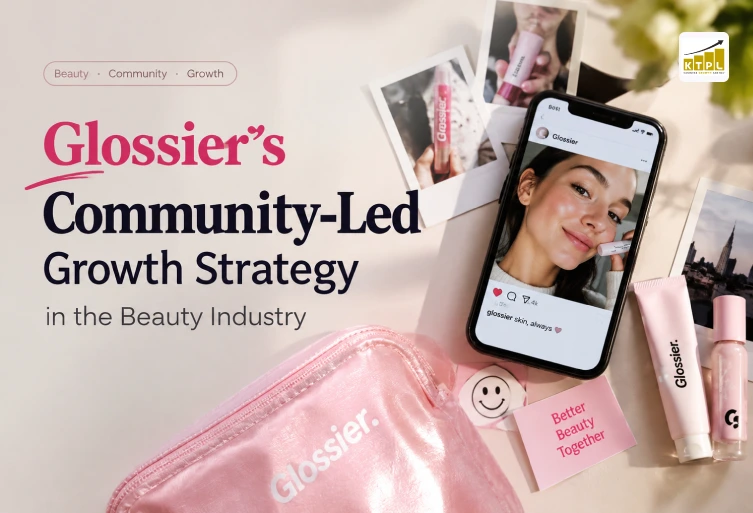
The beauty industry has changed from a market dominated by traditional advertising and celebrity endorsements into one where customers actively influence what brands create, promote, and sell. Social media, online reviews, beauty communities, creators, and word-of-mouth recommendations have made customers important participants in the brand-building process. Glossier is one of the clearest examples of this shift. Instead of building its business around advertising first, the company developed an audience, listened to its interests, and gradually turned those relationships into a beauty brand. Glossier’s Community-Led growth strategy began with content rather than products. Before Glossier launched, founder Emily Weiss created Into The Gloss, a beauty publication focused on interviews, routines, products, and personal experiences. The publication allowed the company to understand how people actually thought about beauty and what they wanted from products. This early audience became an important foundation for the brand when Glossier launched its first products in 2014. The strategy is valuable because it connects several areas of modern marketing: content marketing, customer research, product development, user-generated content, community building, social media, and direct-to-consumer commerce. Rather than treating customers as passive buyers, Glossier encouraged them to participate in conversations around the brand. Their feedback, recommendations, photographs, and experiences helped create a wider ecosystem around the products.For businesses studying community-led growth, Glossier offers an important lesson: a strong customer relationship can begin before a product is sold. Useful content can attract the right audience, conversations can reveal customer needs, and customer participation can eventually support awareness and word-of-mouth growth. The following sections explain how this model developed and what businesses can learn from it.
From Into The Gloss to a Beauty Community
Glossier’s Community-Led strategy can be traced directly to Into The Gloss, which Emily Weiss launched in 2010. Rather than creating a conventional beauty website focused primarily on selling products, the publication explored the real routines and preferences of people interested in beauty. Articles and interviews gave readers insight into skincare habits, makeup choices, favourite products, and everyday beauty experiences. This content-first approach helped build an audience before Glossier existed as a product company. The biggest advantage of this early approach was the opportunity to listen. Readers were already discussing what worked for them, what they disliked about existing products, and what they wished beauty companies would create. These conversations provided useful customer insights that traditional advertising could not easily provide. Instead of beginning with the assumption that the company knew what consumers wanted, Glossier could observe real conversations and identify recurring needs. This helped create a relationship between the brand and its audience before the company introduced its own products. By the time Glossier launched in 2014, it was not starting entirely from zero. The audience developed through Into The Gloss already had an interest in the brand’s approach to beauty and had become familiar with its editorial voice. Content had therefore helped establish awareness and trust before the product launch. The transition from Into The Gloss to Glossier also demonstrates the value of building an audience around a subject rather than immediately pushing sales messages. The publication provided information and entertainment while simultaneously creating a source of market knowledge. Readers were able to participate in conversations, while the business gained a better understanding of its potential customers. This approach remains relevant for businesses in many industries. A company does not necessarily need to launch with aggressive promotional campaigns to build an audience. It can first create useful content around customer problems, answer common questions, share practical information, and encourage discussion. Over time, these interactions can reveal what customers need and create a stronger foundation for future products and services. For SEO, AEO, and GEO-focused businesses, the same principle is particularly useful. Search-friendly content should not only target keywords; it should answer genuine questions and reflect the language customers use. When businesses understand their audience first, they can create content that is more relevant to search intent while also building familiarity and trust.
Customer Feedback as a Product Development Strategy
A major part of Glossier’s Community-Led growth model was the connection between customer conversations and product development. The audience surrounding Into The Gloss provided insight into beauty routines, frustrations, preferences, and unmet needs. Instead of viewing customer feedback simply as a response to products that had already been launched, Glossier could use these conversations to understand what its audience wanted from future products. This approach is particularly valuable in the beauty industry because customers have highly personal preferences. Texture, packaging, application, finish, convenience, ingredients, and routine can all influence whether someone likes a beauty product. A business that relies only on internal assumptions may overlook these small but important details. Listening to customers provides another source of information that can help identify recurring patterns. Glossier’s approach did not mean that every customer request automatically became a product. Effective customer-led development requires businesses to evaluate feedback alongside research, testing, quality standards, costs, and overall business strategy. The value of community feedback comes from recognising repeated needs and understanding why customers are asking for something. For example, if customers repeatedly discuss difficulty finding a convenient product for a particular part of their routine, that conversation may reveal a broader market opportunity. Similarly, recurring complaints about packaging or application can highlight areas where an existing category could be improved. When these observations are collected over time, they become more useful than individual comments viewed in isolation. This creates a feedback loop between the business and its customers. Customers share experiences and expectations, the company learns from those conversations, products and experiences can be refined, and customers can then respond to the results. This continuous process is one of the strongest aspects of a community-led business model because the relationship does not end when a transaction takes place. Businesses outside beauty can apply the same approach. Reviews, customer-support conversations, social media comments, surveys, forums, search queries, and community discussions can all provide useful insights. These sources can help businesses understand what customers struggle with and what information they need. Those insights can then influence products, website content, FAQs, marketing campaigns, and customer experience. For KTPL – Business Growth Agency, the broader lesson is that digital growth works best when visibility is connected with genuine customer understanding. SEO may bring people to a website, while AEO and GEO can help a business answer questions across modern search experiences. But the content becomes much more useful when it is based on the real questions, language, and problems of the target audience. Glossier’s early community-building approach demonstrates how listening can become a strategic part of growth rather than simply a customer-service activity.
User-Generated Content, Community Advocacy and Shareable Branding
Glossier’s Community-Led growth strategy became stronger as customers started contributing to the brand through photographs, reviews, beauty routines, recommendations, and social media posts. This user-generated content gave the company a way to communicate through real customer experiences rather than relying entirely on polished advertising. When people shared how they used Glossier products in their everyday routines, potential customers could see the products in a more relatable context. This helped turn customers into participants in the brand’s communication rather than simply recipients of marketing messages. User-generated content can also extend a brand’s reach beyond its own channels. A customer sharing a product photograph or recommendation can introduce the brand to people who may never have encountered its website or advertising. In beauty, this can be particularly valuable because customers often look for demonstrations, reviews, routines, and personal experiences before purchasing a product. Glossier’s community therefore became an additional source of product discovery and social proof. The brand also developed a distinctive visual identity that supported sharing. Its recognisable pink packaging, pouches, stickers, and clean aesthetic became part of the customer experience. These elements made products visually identifiable when customers photographed or posted them online. However, the important lesson is not simply to make packaging attractive. Shareable branding works best when it is combined with a useful product and an experience customers genuinely want to discuss. Glossier also created its Rep Program, which gave selected community members opportunities to promote the brand through referral mechanisms and other benefits. This formalised some of the word-of-mouth activity already happening within the community. Instead of depending only on large-scale advertising, the company could encourage enthusiastic customers to introduce products to their own networks. Referral codes and similar mechanisms also provided a way to connect advocacy with measurable business activity. Community advocacy works differently from traditional advertising because the recommendation can come through an existing relationship. A customer, creator, or community member may already have credibility with their audience, making the introduction feel more personal. However, businesses need to maintain transparency when incentives, commissions, or other benefits are involved. Community trust can be strengthened when people understand the nature of the relationship rather than feeling that recommendations are disguised advertisements. For businesses considering this model, the main lesson is to give customers genuine reasons to participate. A company can encourage reviews, create referral programs, invite customers to share experiences, feature useful community content, or build spaces where users can exchange ideas. The objective should not be to turn every customer interaction into a sales message. Strong communities are built when customers receive value and have meaningful opportunities to contribute.
Business Impact and Lessons for Modern Brands
Glossier’s Community-Led model shows how content, customer feedback, user-generated content, advocacy, and brand experience can work together as a connected growth system. The company began by developing an audience around Into The Gloss, learned from that audience, introduced products, and encouraged customers to become part of the ongoing conversation. This created several paths through which people could discover and interact with the brand, including editorial content, social media, customer recommendations, product reviews, and community-generated material. One important advantage of this approach is that customer relationships can continue generating value after the initial purchase. In a traditional advertising model, a company may pay repeatedly to reach new audiences. In a community-led model, existing customers can contribute to awareness by sharing experiences and recommendations. This does not eliminate the need for advertising or other acquisition channels, but it can create additional organic pathways for discovery and engagement. Glossier’s growth also illustrates why community-led marketing should not be confused with simply having a large social media following. A community is more valuable when people actively participate, provide feedback, create content, recommend products, and interact with the brand or with one another. Followers alone do not necessarily create meaningful customer relationships. The quality of participation and the relevance of the community to the business matter considerably. There are also practical limitations. Community building requires time, consistent communication, and a product or service that gives people a reason to stay engaged. Negative customer experiences can spread through the same networks that amplify positive recommendations. Businesses therefore need to treat community feedback as both a marketing opportunity and a source of accountability. Listening to customers is valuable only when the company is prepared to learn from what it hears. For modern brands, Glossier’s experience provides several practical lessons. Businesses can start by creating useful content around customer problems, monitoring conversations to identify recurring needs, using feedback to improve products and services, encouraging authentic customer reviews, and making it easy for satisfied customers to share their experiences. These activities can work alongside SEO, AEO, GEO, social media marketing, email marketing, and direct customer engagement. The most transferable lesson from Glossier’s Community-Led strategy is that customers can become an active part of brand growth when businesses create genuine value and listen consistently. Glossier did not begin with a large product portfolio; it began by understanding an audience through content and conversation. That foundation helped connect product development, marketing, customer experience, and community participation into a single growth model. For businesses such as KTPL – Business Growth Agency and other companies studying modern digital growth, the case highlights an important shift in marketing: customers are not only people businesses communicate with; they can also become sources of insight, content, recommendations, and brand awareness. When those relationships are built around useful products and authentic experiences, community can become an important part of long-term brand development.
FAQs
Have questions? We’ve answered some of the most common queries to help you understand the topic better.
Q1. What is Glossier’s Community-Led growth strategy?
It is an approach centred on customer participation, feedback, content, recommendations, and community engagement.
Q2. How did Into The Gloss help Glossier?
It helped Emily Weiss build an engaged beauty audience and understand customer interests before Glossier launched its products.
Q3. How does user-generated content support Glossier?
Customer photos, reviews, routines, and recommendations provide authentic product experiences and additional opportunities for brand discovery.
Q4. What was Glossier’s Rep Program?
It gave selected community members ways to promote Glossier through referral-based activities and associated benefits.
Q5. What can businesses learn from Glossier?
Businesses can build stronger relationships by listening to customers, creating useful content, improving products from feedback, and encouraging authentic participation.
Want To Grow Your Business - Connect With KTPL
KTPL – Business Growth Agency, a creative solutions and business growth agency from India.
👉 Visit https://kirnanitechnologies.com
📞 Call us at +91 95093 33000
📧 Email us at contact@kirnanitechnologies.com


