


Calendly is one of the clearest examples of how a simple product, when designed intelligently, can achieve massive adoption without relying on traditional marketing. It didn’t win because it had the most features—it won because it removed friction from a universal problem: scheduling meetings.
What makes Calendly’s journey remarkable is not just its growth, but how it grew. Instead of pushing the product through ads, it allowed users to naturally spread it through everyday use. This created a self-sustaining growth loop that continues even today.
In this detailed breakdown, we’ll explore the mechanics behind Calendly’s viral adoption, why it resonated so strongly with US professionals, and how similar strategies can be applied to modern businesses.
The Problem Calendly Solved (And Why It Mattered)
- “Are you free at 3 PM?”
- “No, how about 5 PM?”
- “That doesn’t work, what about tomorrow?”
- Set their availability
- Share a single link
- Let others pick a suitable time
The importance of this cannot be overstated. When a product removes friction from a repetitive task, it naturally becomes indispensable.
Simplicity as a Growth Strategy
Calendly’s simplicity was not accidental—it was strategic. Instead of building a complex platform with dozens of features, it focused on doing one thing extremely well.
- Users understood the product instantly
- Onboarding required almost no effort
- There was no learning curve
- Adoption felt natural, not forced
Even today, its interface remains clean and intuitive. This consistency reinforces trust and usability.
Product-Led Growth: Letting the Product Do the Work
Calendly is a textbook example of product-led growth. Instead of relying on sales teams or aggressive campaigns, it allowed the product itself to drive adoption.
- Users experienced value immediately
- There was no need for demonstrations
- The product explained itself through usage
This instant gratification is critical. If users see value within minutes, they are far more likely to continue using the product.
The Viral Loop That Powered Everything
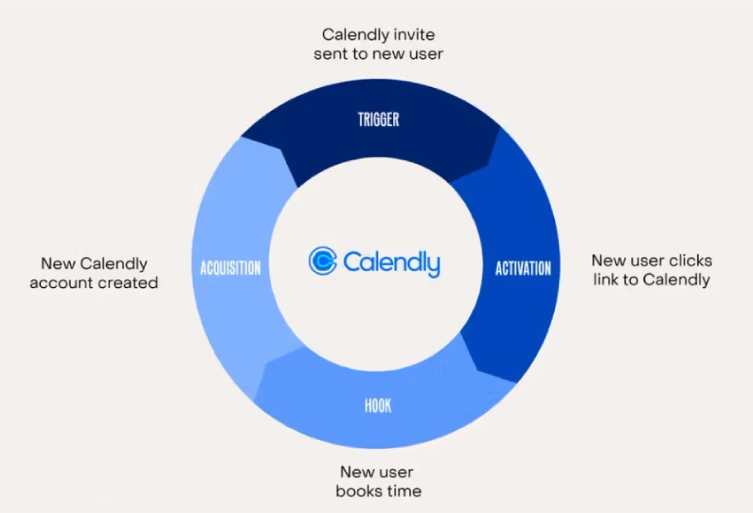
The real engine behind Calendly’s growth was its viral loop. Unlike traditional referral systems that require users to actively promote a product, Calendly embedded sharing directly into its core functionality.
Every interaction became a growth opportunity.
How the Viral Loop Works
- A user sends a Calendly link to schedule a meeting
- The recipient clicks the link and selects a time
- The recipient experiences how easy the process is
- The recipient starts using Calendly for their own meetings
This cycle repeats continuously, creating exponential growth.
The brilliance of this system lies in its subtlety. Users are not asked to promote the product—it happens naturally as part of their workflow.
Why the Strategy Worked So Well in the US
Calendly’s rapid adoption among US professionals was influenced by several key factors.
High Meeting Frequency
In many US industries, meetings are central to daily operations. Sales calls, client discussions, team syncs—everything revolves around scheduling.
Calendly made this process faster and more efficient, which made it highly valuable.
Strong Preference for Efficiency
US professionals often prioritize tools that save time and increase productivity. Calendly aligned perfectly with this mindset.
Rise of Remote Work
With the shift to remote work, digital scheduling became essential. Calendly provided a reliable and professional solution for virtual meetings.
Professional Standardization
Once a tool becomes common within a professional network, it spreads quickly. Calendly benefited from this network effect, becoming a standard in many industries.
Freemium Model: Removing Barriers to Entry
Calendly’s freemium model played a major role in its growth.
- Try the product without risk
- Integrate it into their workflow
- Experience its benefits firsthand
This approach is far more effective than forcing early monetization, especially for products aiming for mass adoption.
Integration Ecosystem: Fitting Into Existing Workflows
Calendly didn’t try to replace existing tools—it enhanced them.
- Calendar platforms
- Email systems
- Video conferencing tools
- CRM software
Reducing friction at this level significantly increases retention.
Psychological Triggers Behind Adoption
Calendly’s success is also rooted in human psychology.
Convenience Bias
People naturally prefer solutions that require less effort. Calendly reduced effort dramatically.
Social Proof
Receiving multiple Calendly links from different professionals creates trust and familiarity.
Reciprocity
When someone uses Calendly to schedule with you, you’re more likely to use it in return.
Control and Autonomy
Recipients can choose a time that suits them, which creates a sense of control and satisfaction.
These subtle psychological factors contributed significantly to its viral growth.

Scalability Without Complexity
- Individuals can use it for personal scheduling
- Teams can use it for coordination
- Enterprises can use it for large-scale operations
Many tools struggle with this balance—Calendly managed to maintain simplicity while expanding functionality.
Competitive Advantage and Positioning
Calendly didn’t just compete on features—it competed on experience.
- Simplicity
- Ease of use
- Seamless sharing
This highlights an important lesson: better user experience often beats more features.
Lessons Businesses Can Apply
Calendly’s strategy offers several practical lessons for businesses:
Build Around a Core Use Case
Focus on solving one problem extremely well before expanding.
Embed Growth Into the Product
Design features that naturally encourage sharing and usage.
Deliver Immediate Value
Ensure users see benefits within minutes of using your product.
Keep the Experience Simple
Avoid unnecessary complexity that slows down adoption.
Use Freemium Strategically
Allow users to experience value before asking for payment.
Applying This Strategy in Today’s Market
In today’s competitive digital landscape, businesses need smarter growth strategies.
- SaaS platforms
- Service-based businesses
- Digital tools and applications
- Create shareable user experiences
- Reduce onboarding friction
- Focus on usability over feature overload
- Encourage organic growth loops
Challenges and How Calendly Navigated Them
- Increasing competition
- Expanding features without losing simplicity
- Serving both individuals and enterprises
This balance between growth and simplicity is difficult but essential.
The Future of Product-Led Viral Growth
Calendly’s success reflects a larger trend in the digital economy.
Products are no longer just tools—they are growth engines.
- Self-serve models
- User-driven expansion
- Experience-first design
Conclusion
Calendly’s viral adoption strategy is a powerful example of how thoughtful product design can drive massive growth.
By solving a real problem, removing friction, and embedding virality into its core functionality, it created a system where users naturally promote the product.
For businesses, the takeaway is clear: growth doesn’t always come from bigger marketing budgets—it often comes from building better products.
FAQs
Have questions? We’ve answered some of the most common queries to help you understand the topic better
Q1. What is Calendly’s viral loop?
It’s a growth cycle where users share scheduling links, exposing new users to the product and encouraging adoption.
Q2. Why did US professionals adopt Calendly quickly?
Because it saves time, simplifies scheduling, and fits well into digital workflows.
Q3. How does the freemium model help growth?
It allows users to experience value without risk, increasing adoption and eventual upgrades.
Q4. What makes Calendly different from competitors?
Its simplicity, ease of use, and built-in sharing mechanism.
Q5. Can startups replicate this strategy?
Yes, by focusing on usability, solving real problems, and designing products that naturally spread through usage.
Want To Grow Your Business - Connect With KTPL
KTPL – Business Growth Agency, a creative solutions and business growth agency from India.
👉 Visit https://kirnanitechnologies.com
📞 Call us at +91 95093 33000
📧 Email us at contact@kirnanitechnologies.com


