


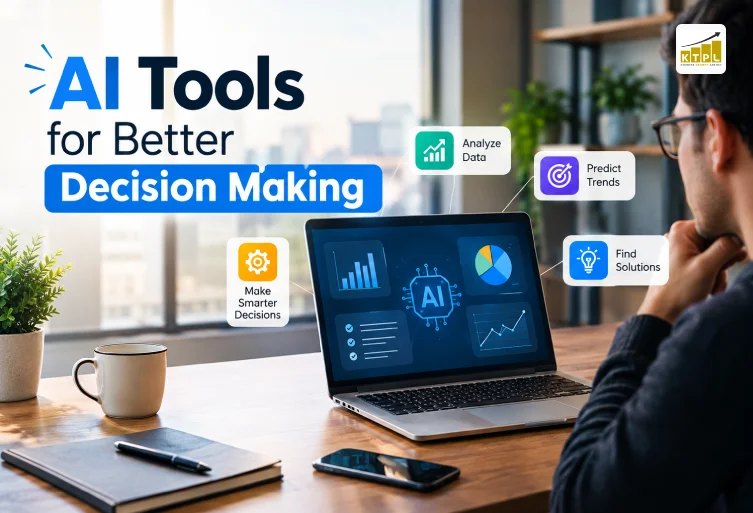
Making the right decision is essential for every business, whether it involves marketing, finance, operations, customer service, sales, or long-term growth. However, modern businesses generate enormous amounts of information every day, making it difficult to review everything manually. This is where AI Tools can provide practical support by analyzing data, identifying patterns, summarizing information, and helping teams explore different possibilities. Instead of depending only on assumptions or manual reports, businesses can use AI-assisted insights to understand situations more clearly and respond faster. From predictive analytics to conversational AI, modern platforms can support different stages of the decision-making process. When used with reliable data and human judgment, these technologies can help organizations make more informed, efficient, and timely business decisions.
Why AI Tools Are Important for Business Decision Making
Businesses often need to make decisions while dealing with incomplete information, changing customer expectations, competitive pressure, and constantly shifting market conditions. Traditional methods such as spreadsheets, manual research, and lengthy reports are still useful, but they can take considerable time when large datasets are involved. AI Tools can process substantial amounts of information much faster and highlight patterns that may be difficult to identify through manual analysis. They can help managers compare options, summarize research, identify unusual changes, and explore possible future scenarios. For example, a company can analyze sales data to understand product performance or examine customer feedback to identify recurring problems. AI can also reduce repetitive analytical work, allowing employees to spend more time interpreting results and developing strategies. The goal is not to remove people from the decision-making process but to provide them with better information and a more efficient way to evaluate it.
Top AI Tools for Better Decision Making
Different business decisions require different types of technology, so there is no single tool that works equally well for every organization. Some AI Tools focus on research and information discovery, while others specialize in data visualization, business intelligence, forecasting, or conversational analysis. Rationale AI can help users structure complex choices by comparing alternatives and considering different factors. Rationale AI Perplexity AI can support research by gathering information and presenting answers with source references, making it useful for preliminary market, competitor, and industry research. Perplexity AI For organizations that need business analytics, Microsoft Power BI provides interactive dashboards, reporting, data visualization, and business intelligence capabilities. Microsoft Power BI Tableau is another powerful analytics and visualization platform that helps businesses explore data and communicate insights through interactive reports. Tableau For brainstorming, analysis, research assistance, and organizing complex information, conversational platforms such as ChatGPT and Claude can also be useful. ChatGPT Claude The right choice depends on the organization’s goals, data, budget, workflow, and level of technical expertise.
Key Benefits of AI Tools for Decision Making
The biggest benefit of AI Tools is the ability to reduce the time required to collect, process, and understand information. Instead of manually reviewing large reports, employees can use AI-assisted systems to identify important patterns, summarize information, and focus attention on areas that require further investigation. AI can also support forecasting by examining historical information and current variables to estimate possible future outcomes. In marketing, this can help teams understand campaign performance and customer behavior; in finance, it can assist with identifying unusual transactions or analyzing financial trends; and in operations, it can support demand and resource planning. Another benefit is improved consistency because automated analysis can follow defined processes without becoming tired or distracted by repetitive work. AI can also help teams compare multiple scenarios before making a major investment or operational change. However, these benefits depend on the quality of the data and the way the technology is implemented, so AI-generated insights should always be reviewed in the appropriate business context.
How Businesses Can Use AI Tools
AI Tools can be applied across almost every major business function because decision-making is involved in nearly every department. Marketing teams can analyze customer behavior, campaign performance, search trends, and engagement data to improve their strategies. Sales teams can use AI-assisted analysis to identify customer patterns, evaluate leads, and understand sales performance. Finance teams can use analytics for forecasting, budgeting, reporting, and anomaly detection, while operations teams can examine inventory, demand, productivity, and resource utilization. Customer service departments can use conversational AI to handle routine questions and identify common customer concerns. Management teams can combine information from different departments to create clearer performance reports and evaluate business opportunities. AI can also help with research by quickly organizing information from multiple sources before a team conducts deeper verification. These applications show that the value of AI is not limited to one department; it can become part of a broader data-driven business workflow.
Best Practices for Implementing AI Tools
Adopting AI Tools successfully requires more than simply selecting a popular platform and introducing it to employees. Businesses should first identify the specific problem they want to solve and define what a successful outcome would look like. Data quality is particularly important because inaccurate, outdated, or incomplete information can produce unreliable results. Companies should also consider data privacy, security, integration requirements, user access, and the overall cost of implementation before selecting a platform. Employees should receive appropriate training so they understand how to use AI effectively and recognize its limitations. For high-impact decisions, human oversight should remain an important part of the workflow. Businesses should also regularly evaluate AI outputs rather than assuming that every generated answer or prediction is correct. Starting with a focused use case can make implementation easier and allow an organization to measure actual value before expanding AI across additional departments.
Challenges and Limitations of AI Tools
Although AI Tools can improve business analysis, they are not free from limitations. AI systems may produce inaccurate information, misunderstand context, or generate conclusions based on incomplete or poor-quality data. Predictive systems can also struggle when market conditions change unexpectedly or when historical patterns no longer represent current behavior. Privacy and security are additional considerations, especially when businesses work with sensitive customer, financial, or internal information. Another challenge is over-reliance on automated recommendations. A decision may look logical from a dataset while missing important factors such as customer relationships, company culture, industry conditions, or long-term strategic priorities. Employees may also require time to learn new platforms and adapt existing workflows. For these reasons, AI should generally be used as a decision-support resource rather than an unquestionable authority. Combining automated analysis with professional knowledge and human review creates a more balanced approach.
Future of AI Tools in Business Decision Making
The role of AI Tools in business is expected to continue expanding as organizations collect more digital information and adopt increasingly connected systems. Future AI applications will likely provide more real-time analysis, automated reporting, predictive insights, and natural-language interaction with business data. Instead of manually opening several reports, managers may increasingly be able to ask questions about business performance and receive relevant information from connected datasets. AI can also help organizations identify important changes earlier, allowing teams to investigate potential problems before they become larger operational issues. At the same time, businesses will need stronger data governance, security controls, and human oversight as AI becomes more deeply integrated into everyday processes. The most useful approach will be to focus on practical business outcomes rather than adopting AI simply because it is a growing technology trend. Organizations that connect AI adoption with clear objectives, reliable data, and measurable results can create more efficient decision-making processes.
How KTPL – Business Growth Agency Can Help
At KTPL – Business Growth Agency, businesses can explore digital strategies that connect technology with practical growth objectives. Choosing the right AI solution requires understanding the business problem first, followed by an evaluation of available data, existing workflows, budget, and future requirements. AI can support areas such as research, reporting, marketing analysis, automation, customer insights, and strategic planning when it is implemented with a clear purpose. KTPL can help businesses look at technology from a broader growth perspective rather than treating AI as an isolated software purchase. A practical approach involves identifying repetitive processes, information gaps, reporting challenges, and opportunities where faster analysis could improve business performance. With the right combination of technology, reliable information, and human expertise, businesses can make their workflows more efficient while maintaining control over important decisions.
Conclusion
AI Tools are changing the way businesses collect information, analyze data, evaluate opportunities, and plan for the future. From research platforms and conversational assistants to business intelligence and predictive analytics, different AI solutions can support different stages of decision-making. Their greatest value comes from helping teams process information faster, identify meaningful patterns, and explore possibilities that may otherwise require significant manual effort. However, AI should not replace human judgment, particularly when decisions involve financial, operational, customer, or strategic consequences. Businesses should focus on reliable data, clear objectives, responsible implementation, and regular review of AI-generated insights. When technology is combined with human experience and sound business processes, AI Tools can become a valuable part of a modern, data-driven decision-making strategy.
FAQs
Have questions? We’ve answered some of the most common queries to help you understand the topic better.
Q1. What are AI Tools?
It is an approach centred on customer participation, feedback, content, recommendations, and community engagement.
Q2. How do AI Tools improve business decisions?
They help businesses process data faster, identify patterns, compare options, forecast possibilities, and organize complex information.
Q3. Which AI Tools are useful for business analytics?
Power BI and Tableau are widely used for business intelligence, dashboards, reporting, and data visualization.
Q4. Can AI completely replace human decision-makers?
No. AI can support analysis, but important decisions still require human judgment, context, and professional expertise.
Q5. Are AI Tools useful for small businesses?
Yes. Small businesses can use AI for research, marketing, reporting, customer service, productivity, and other repetitive business tasks.
Want To Grow Your Business - Connect With KTPL
KTPL – Business Growth Agency, a creative solutions and business growth agency from India.
👉 Visit https://kirnanitechnologies.com
📞 Call us at +91 95093 33000
📧 Email us at contact@kirnanitechnologies.com


