


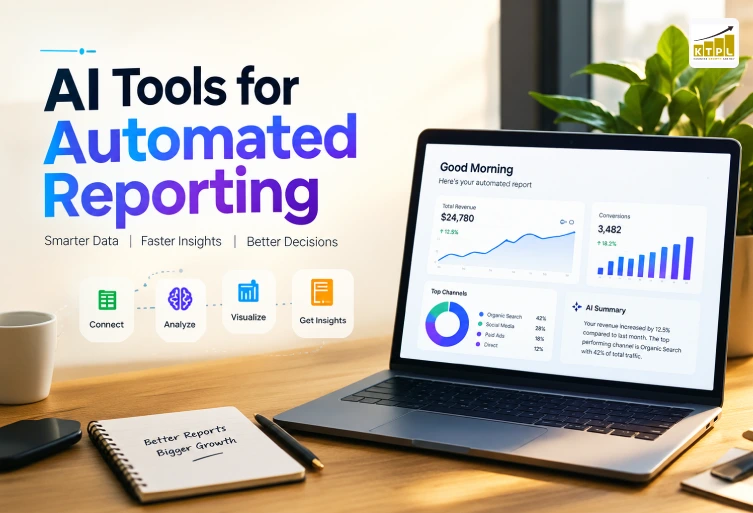
Businesses generate large amounts of data every day through sales, marketing, finance, customer service, websites, CRM systems, and other digital platforms. Turning this information into useful reports, however, can still require hours of manual work. Teams often spend time collecting data, checking spreadsheets, creating charts, formatting reports, and preparing summaries for management. AI tools for automated reporting are helping businesses simplify this process. These platforms can connect with different data sources, organize information, create dashboards, identify important changes, and generate understandable summaries. Some tools also allow users to ask questions about their data using natural language. For businesses, the goal is not simply to create reports faster. The bigger opportunity is to make reliable information available at the right time so teams can spend less time preparing reports and more time making informed decisions.
What Are AI Tools for Automated Reporting?
AI tools for automated reporting are software solutions that use artificial intelligence, automation, analytics, and data integrations to turn raw business information into structured reports and insights. Instead of manually collecting information from multiple systems, businesses can connect their data sources to a reporting platform and automate recurring reporting tasks. These tools can work with sources such as Google Sheets, CRM platforms, advertising accounts, website analytics, databases, accounting software, and marketing platforms. Once connected, data can be refreshed automatically according to the reporting requirements. Modern AI reporting platforms can go beyond traditional dashboards. Depending on the platform, users may be able to ask questions in natural language, receive automated summaries, identify unusual changes, or explore trends through interactive visualizations. For example, instead of manually reviewing several spreadsheets to understand monthly sales performance, a manager could use an automated dashboard to view revenue, conversion rates, sales trends, and other key metrics in one place. This makes automated reporting particularly useful for companies that regularly work with large volumes of data or prepare the same reports every week or month.
How AI Automated Reporting Works
The automated reporting process generally starts by connecting the required data sources to an analytics or business intelligence platform. These sources might include spreadsheets, CRM software, marketing platforms, databases, e-commerce systems, or financial applications. The reporting platform then collects and organizes the information so that relevant metrics can be analyzed together. For example, marketing expenditure can be compared with leads and sales data to understand campaign performance. AI capabilities can then help users explore the information, identify patterns, summarize results, or detect unusual changes. Some platforms allow users to ask questions using everyday language instead of manually creating complex queries. Once the reporting workflow is configured, dashboards can be updated automatically and reports can be scheduled for specific users or teams. Alerts can also be created for important changes, such as a sudden increase in advertising costs or a drop in website conversions. However, automation does not remove the importance of data quality. Incorrect, incomplete, or inconsistent source data can produce unreliable reports. Businesses should therefore clean their data and establish clear definitions for important metrics before fully automating reporting.
Key Benefits of AI Tools for Automated Reporting
The biggest advantage of AI tools for automated reporting is the reduction of repetitive work. Employees no longer need to manually collect information from different systems every time a recurring report is required. Automated workflows can handle much of the data collection, formatting, visualization, and distribution process. Another major benefit is faster access to information. When reports update automatically, managers can review current performance without waiting for someone to prepare a spreadsheet. This can be particularly useful for marketing, sales, e-commerce, and other areas where performance changes frequently. AI reporting can also improve consistency. A standardized reporting workflow can use the same calculations, metrics, formatting, and reporting schedule each time. This reduces the possibility of differences between manually prepared reports. Automated alerts provide another useful capability. Instead of discovering an important problem during a weekly meeting, teams can receive notifications when selected metrics change significantly.
Key benefits include:
- Time savings: Reduces repetitive reporting tasks.
- Faster insights: Makes updated information available sooner.
- Better consistency: Uses standardized reporting processes.
- Automated alerts: Highlights important changes.
- Easy data exploration: Allows users to investigate information more efficiently.
- Improved decision-making: Gives teams quicker access to relevant business metrics.
- Scalable reporting: Makes recurring reporting easier as a business grows.
Top AI Tools for Automated Reporting
Several business intelligence and reporting platforms now offer AI-assisted analytics, automation, visualization, or natural-language capabilities. The right choice depends on the company’s data sources, reporting requirements, technical resources, budget, and business goals. Zoho Analytics is a business intelligence and analytics platform that can connect data from different sources and create dashboards and reports. Its AI-assisted features can help users explore information and interact with business data more naturally. It can be particularly relevant for organizations already using the wider Zoho ecosystem. ThoughtSpot focuses strongly on search-driven analytics and natural-language data exploration. Instead of relying entirely on traditional dashboard navigation, users can interact with connected data through search and conversational analytics. This can make data exploration more accessible to business users. Improvado is strongly focused on marketing data integration and analytics. It can help businesses and agencies bring information from multiple marketing platforms into centralized reporting workflows. This can be useful for organizations managing data from numerous advertising and marketing channels. Tableau is widely known for advanced data visualization and business intelligence. It allows organizations to build interactive dashboards and explore complex datasets visually. Its analytics capabilities can support a broad range of business reporting requirements. Businesses should not select a reporting platform only because it has an AI feature. The more important questions are whether it supports the required data sources, provides reliable reporting, meets security requirements, fits the budget, and can be used effectively by the intended team.
AI Reporting for Marketing, Sales, and Business Teams
Marketing teams can use automated reporting to bring campaign data from advertising platforms, website analytics, CRM systems, and other marketing channels into a centralized reporting environment. This makes it easier to monitor metrics such as leads, conversions, advertising costs, and return on investment. Sales teams can connect CRM information to dashboards that track leads, opportunities, conversion rates, pipeline value, and revenue. Automated reporting can reduce the need for sales managers to repeatedly request or prepare performance spreadsheets. Business owners and management teams can use automated dashboards to monitor broader business metrics, including revenue, customer acquisition, operational performance, and growth trends. The advantage is not simply having more dashboards. Effective reporting should make important information easier to understand and connect that information with business decisions. For example, a report showing that website traffic increased is useful, but understanding whether that traffic produced more qualified leads or sales is more valuable. AI-powered reporting can help teams move from simply viewing numbers toward understanding relationships between important metrics.
How to Choose the Right AI Reporting Tool
Choosing the right AI tools for automated reporting starts with identifying the actual reporting problem. Businesses should first determine which reports take the most time to prepare and which data sources are required to create them. The next step is to evaluate integrations. A platform may offer excellent AI capabilities, but if it cannot reliably connect to the company’s CRM, advertising platforms, database, or spreadsheet system, it may not solve the underlying problem. Businesses should also consider ease of use, dashboard capabilities, automation options, data security, user permissions, scalability, pricing, customer support, and reporting accuracy. A small business may need a simple reporting solution with a few integrations, while a larger organization may require advanced data warehousing, governance, and complex analytics. Before committing to a platform, businesses can test one important reporting workflow. Comparing the automated output with an existing manually prepared report can help identify data, calculation, or integration issues before the system is expanded.
Best Practices for Automated Reporting
Successful automated reporting depends on more than selecting software. Businesses should first establish clean and consistent data because automation cannot fix unreliable source information by itself. Important metrics should have clear definitions. For example, marketing and sales teams should agree on what qualifies as a lead, customer, conversion, or qualified opportunity. This prevents different departments from interpreting the same metric differently. Reports should also focus on useful information rather than displaying every available metric. Too many numbers can make dashboards difficult to understand and hide the indicators that actually matter. Human review remains important as well. AI-generated summaries and automated insights should be checked when they influence significant business decisions. A practical approach is to start with one recurring report, automate it, validate the results, gather feedback from users, and then gradually expand the reporting system.
Future of AI-Powered Automated Reporting
The future of business reporting is moving toward more interactive and proactive analytics. Traditional dashboards primarily show users what has already happened, while newer AI-powered systems can help identify unusual changes, answer questions, and summarize important developments. Natural-language analytics is also making business data easier to access. Users who do not have advanced technical skills can increasingly interact with data through conversational questions rather than relying entirely on complex queries. Another important development is proactive reporting. Instead of requiring managers to constantly check dashboards, automated systems can highlight significant changes and send relevant alerts based on predefined conditions. Despite these developments, data governance, security, privacy, and human validation will remain essential. Businesses will need to balance automation with appropriate controls to ensure that automated insights are based on reliable information. The organizations that gain the most value from AI reporting will likely be those that combine automation with strong data practices and human decision-making rather than treating AI as a complete replacement for analytical expertise.
Conclusion
AI tools for automated reporting are helping businesses reduce repetitive reporting work while gaining faster access to useful information. By connecting data sources, automating recurring reports, generating visualizations, detecting changes, and supporting natural-language analytics, these platforms can make business reporting more efficient. However, successful automation requires more than simply adopting an AI platform. Businesses need reliable data, clearly defined metrics, appropriate integrations, secure workflows, and human oversight. For businesses looking to improve reporting, analytics, digital processes, and overall growth, KTPL – Business Growth Agency can help identify opportunities where technology and automation can improve existing workflows. The best starting point is simple: identify the report that consumes the most manual effort, understand the data behind it, and explore how automation can make that process faster, clearer, and more reliable.
FAQs
Have questions? We’ve answered some of the most common queries to help you understand the topic better.
Q1. What are AI tools for automated reporting?
They are platforms that use AI, automation, and analytics to collect, analyze, visualize, summarize, and distribute business data.
Q2. Can AI reporting tools work with Google Sheets?
Yes. Many reporting platforms support Google Sheets or provide integrations that allow spreadsheet data to be used in automated reports.
Q3. Can AI reporting tools connect with CRM systems?
Yes. Many platforms can connect with CRM data to create dashboards covering leads, opportunities, sales, customers, and revenue.
Q4. Are automated AI reports always accurate?
Not necessarily. Accuracy depends on the source data, configuration, calculations, integrations, and capabilities of the reporting platform. Important results should be validated.
Q5. Which businesses can use automated reporting?
Marketing agencies, sales teams, e-commerce companies, startups, service businesses, finance teams, and larger enterprises can all use automated reporting.
Want To Grow Your Business - Connect With KTPL
KTPL – Business Growth Agency, a creative solutions and business growth agency from India.
👉 Visit https://kirnanitechnologies.com
📞 Call us at +91 95093 33000
📧 Email us at contact@kirnanitechnologies.com


