


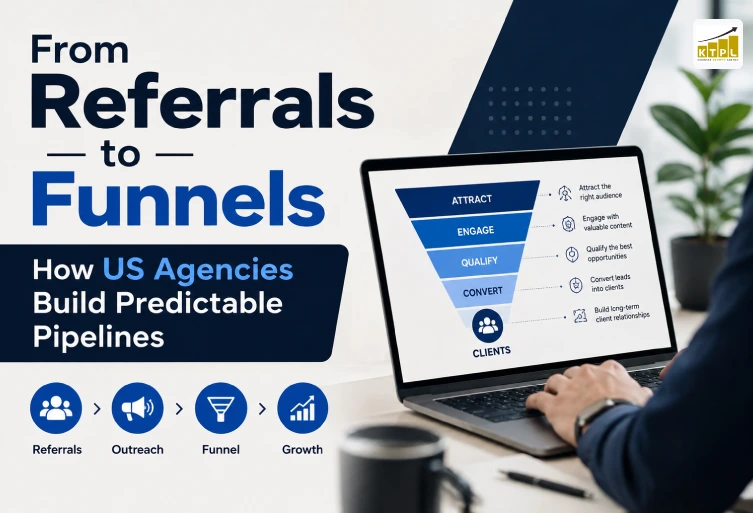
Getting clients through referrals is one of the strongest forms of growth for an agency because the prospect already receives some level of trust before speaking with the sales team. However, referrals alone can make growth difficult to predict. A US agency may receive several valuable introductions in one month and almost none the next, even when its services, team, and reputation remain unchanged. This uncertainty becomes more noticeable as an agency grows and needs a regular flow of new projects to support employees, delivery teams, marketing costs, and revenue targets. That is why many US agencies are moving from referral-dependent growth toward a combination of targeted outreach, content marketing, lead qualification, landing pages, sales funnels, follow-up systems, and CRM management. The purpose is not to replace referrals, but to build a repeatable process around them and create additional ways to generate qualified opportunities. When referrals, outbound marketing, inbound traffic, and sales processes work together, an agency has much better visibility into where its next opportunities may come from.
Why Referral-Only Growth Is Not Enough for US Agencies
Referrals can bring highly relevant prospects, but they are difficult to control because the agency cannot decide exactly when an existing customer or business connection will make an introduction. US agencies that depend almost entirely on referrals can therefore experience an uneven sales cycle, with periods of strong demand followed by months where the pipeline becomes noticeably quieter. This often creates a common problem: when the agency is busy delivering client work, the founder and team stop spending time on business development, and when existing projects finish, there are not enough new opportunities ready to replace them. A structured acquisition process helps solve this gap by allowing lead generation and sales activity to continue even when delivery teams are occupied. Instead of asking, “Who can refer us to someone?” the agency can also ask, “Which companies fit our ideal customer profile, where can we reach them, and what problem can we help them solve?” This change gives US agencies greater control over their sales activity without reducing the importance of relationships and recommendations. The first step is understanding that referrals are not a bad growth channel; the problem is making them the only growth channel. A satisfied client can introduce an agency to another company with a similar problem, and that introduction may convert faster than a completely cold prospect. However, an agency’s existing network has a natural limit. One client may know only a few companies that match the agency’s preferred industry, budget, location, company size, or service requirements. A predictable pipeline expands the agency’s reach beyond that immediate network. Search engine optimization can attract people already looking for a solution, educational content can build trust before a sales call, outbound campaigns can reach selected businesses directly, and partnerships can introduce the agency to new audiences. When these channels are connected to a clear sales process, referrals become one part of a larger client acquisition strategy rather than the foundation that everything depends upon.
How US Agencies Build a Predictable Pipeline
A predictable pipeline starts with a clear understanding of the type of customer an agency wants to work with. US agencies should avoid trying to market every service to every possible business because broad targeting often produces weak messaging and poorly qualified leads. An ideal customer profile can include factors such as industry, company size, revenue range, location, technology used, business model, growth stage, current challenges, and purchasing ability. Once this profile is clear, the agency can create offers and marketing messages that speak directly to the needs of those businesses. This makes it easier to select appropriate acquisition channels and determine which prospects deserve attention. Instead of measuring success only by the number of leads generated, the agency can focus on the number of relevant companies entering the pipeline and the percentage that become genuine sales opportunities. This approach creates a more useful connection between lead generation, qualification, sales activity, and revenue growth. The next step is creating a multi-channel system that gives the agency several ways to attract potential customers. For some US agencies, this may include SEO and service-focused content that captures search demand. For others, LinkedIn outreach, personalized email campaigns, industry networking, strategic partnerships, webinars, paid advertising, or account-based marketing may produce better results. The right combination depends on where the agency’s ideal customers spend time and how they normally make purchasing decisions. The goal is not to be present on every platform or launch dozens of campaigns simultaneously. A smaller number of well-managed channels is often easier to measure and improve. When each channel sends prospects toward a clear conversion point, the agency can begin building a consistent marketing funnel instead of generating disconnected marketing activity. A funnel gives potential clients a logical path from initial interest to a sales conversation. A prospect may first discover an agency through a Google search, LinkedIn post, recommendation, advertisement, or educational article. They may then visit a service page, read a case study, download a useful resource, complete an inquiry form, or book a consultation. Each stage should answer an important question and make the next step clear. For US agencies, this structure is valuable because it creates a process that does not depend entirely on a salesperson manually explaining everything to every prospect. The website, content, landing pages, forms, and follow-up process can do part of the early communication before a sales representative becomes directly involved. This makes the buying journey easier to understand for both the prospect and the agency. A predictable pipeline also requires consistency. Publishing one article, sending one email campaign, or making a few sales calls will not create a reliable acquisition system by itself. US agencies need to establish repeatable activities and monitor the results over time. If outbound prospecting is part of the strategy, there should be a defined target audience, messaging approach, outreach schedule, follow-up process, and method for recording responses. If SEO is a major channel, the agency needs useful content targeting relevant problems and commercial search terms rather than publishing random articles. If referrals are important, the agency can maintain relationships with existing clients and partners and create a natural process for requesting introductions after successful project milestones. Consistency turns individual marketing actions into a business development system that can be measured and improved.
From Leads to Qualified Sales Opportunities
Generating more leads does not automatically mean generating more business. US agencies need to distinguish between someone who has shown interest and someone who is genuinely suitable for the agency’s services. A person may complete a contact form because they are comparing prices, researching options, looking for free advice, or simply exploring an idea. Another prospect may have a real business need but lack the budget, timeline, decision-making authority, or internal resources required for a successful engagement. Without qualification, sales teams can spend large amounts of time on opportunities that were unlikely to convert from the beginning. A simple qualification process can collect useful information before a discovery call, allowing the agency to understand the prospect’s business, goals, current situation, expected timeline, and requirements. This helps the sales team prepare better conversations while giving prospects a clearer and more professional experience. Qualification should not be designed as a barrier that makes it difficult for genuine customers to contact the agency. Instead, it should help both sides determine whether there is a reasonable fit. US agencies can use website forms, consultation questionnaires, booking pages, interactive forms, or initial sales conversations to gather relevant information. A web development agency, for example, may ask about the current website, required features, project timeline, integrations, and approximate investment range. A digital marketing agency may ask about the current acquisition channels, business goals, target market, existing campaigns, and expected growth objectives. These questions provide context before the sales meeting and can help the agency prioritize opportunities according to their potential value and fit. The result is a cleaner pipeline where each stage has a purpose. Instead of having hundreds of unorganized contacts, the agency can distinguish between new inquiries, qualified leads, discovery calls, proposals, negotiations, active opportunities, won clients, and lost opportunities. This makes forecasting more realistic and gives business owners a clearer view of what is actually happening inside the sales process. For US agencies, the combination of targeted acquisition and proper qualification is much more valuable than simply increasing the total number of leads. The objective is to create a steady flow of qualified prospects who have a genuine business problem, understand the agency’s value, and have a reasonable possibility of becoming long-term clients.
Building a Sales Funnel That Moves Prospects Forward
A predictable funnel gives US agencies a clear process for turning attention into genuine sales opportunities instead of treating every website visitor or inquiry as a ready-to-buy customer. Once a prospect enters the funnel, each stage should provide useful information and make the next step simple, whether that means reading a service page, viewing a case study, completing a qualification form, or booking a consultation. The agency should make its value clear without overwhelming prospects with too many services, technical details, or unnecessary steps. A focused landing page can explain the problem, the agency’s approach, expected benefits, proof of experience, and the action the visitor should take next. Case studies, testimonials, project examples, and useful educational content can strengthen trust for prospects who are still comparing providers. For US agencies, the best funnel is usually not the most complicated one; it is the one that creates a smooth path between awareness, consideration, qualification, and conversion. The funnel should also reflect how modern buyers actually make decisions. Many prospects research an agency online before contacting its sales team, so the website needs to answer important questions before the first conversation happens. A potential customer may want to know what the agency does, whether it works with businesses similar to theirs, what type of results it has achieved, how the process works, and what happens after submitting an inquiry. Content can answer these questions at different stages of the buyer journey. Informational articles can attract early-stage prospects, service pages can target people with stronger commercial intent, and case studies can support prospects who are comparing agencies. By connecting these resources, US agencies can build a funnel that educates and qualifies prospects while gradually increasing their confidence in the agency.
CRM, Follow-Up and Pipeline Management
A strong funnel needs an organized system behind it, and this is where CRM pipeline management becomes important for growing US agencies. Without a central system, leads can easily become lost between email inboxes, spreadsheets, phone calls, social media messages, and personal notes. A CRM allows the agency to record where each prospect came from, what service they are interested in, what conversations have already taken place, and what action needs to happen next. Sales opportunities can be organized into stages such as new inquiry, contacted, qualified, discovery call, proposal, negotiation, won, or lost. This simple structure gives agency owners a clearer picture of the current sales pipeline and helps sales teams understand their responsibilities. It also creates historical data that can later be used to identify which channels and campaigns are producing the strongest opportunities. Follow-up is equally important because many potential clients do not make a decision immediately after the first conversation. A prospect may need time to discuss the project with a business partner, obtain internal approval, compare proposals, or finalize a budget. US agencies that follow up professionally can remain visible during this decision-making period without putting unnecessary pressure on the prospect. Instead of repeatedly asking whether the client has made a decision, follow-up messages can provide something useful, such as a relevant case study, additional project information, an answer to a previous question, or clarification about the proposed approach. A consistent follow-up process also prevents promising opportunities from being forgotten simply because the sales team becomes busy with current client work. When follow-up is recorded and scheduled inside the CRM, the agency can maintain relationships more consistently and improve the chances of converting qualified opportunities.
Measuring What Actually Creates Revenue
A predictable pipeline cannot be managed effectively through assumptions alone. US agencies need to measure the movement of prospects through each stage so they can understand what is working and where improvements are needed. Important indicators can include the number of new leads, qualified lead rate, discovery calls booked, proposal conversion rate, close rate, average deal value, sales cycle length, customer acquisition cost, and revenue generated by each acquisition channel. These numbers provide a clearer picture than simply counting website inquiries or social media responses. An agency may discover that one campaign produces a large number of leads but very few qualified opportunities, while another channel generates fewer leads but produces significantly more paying clients. Without measurement, it is difficult to see this difference. Pipeline data can also reveal problems inside the sales process. If many prospects become qualified but very few book discovery calls, the agency may need to improve its offer or booking experience. If discovery calls are strong but proposals rarely close, the problem could be positioning, pricing, sales communication, proposal quality, or follow-up. If proposals regularly close but the pipeline remains small, the agency may need to improve lead generation and increase the number of qualified prospects entering the funnel. This stage-by-stage approach allows US agencies to improve one part of the system at a time instead of changing their entire marketing strategy whenever revenue slows down. Over time, these measurements create a more reliable foundation for sales forecasting and agency growth.
Creating a Balanced Acquisition System
The strongest pipeline does not depend entirely on one marketing channel. US agencies can combine referrals, organic search, content marketing, outbound sales, LinkedIn outreach, email campaigns, strategic partnerships, paid advertising, and other relevant acquisition methods according to their target market. Each channel has a different role, and the agency should focus on the channels that match the behavior of its ideal customers. Referrals can provide warm opportunities, SEO can capture existing search demand, outbound campaigns can proactively reach selected companies, and content can build authority before a prospect contacts the agency. When these activities connect to the same funnel and CRM, they become parts of one broader agency lead-generation system rather than isolated marketing efforts. This does not mean that an agency needs to launch every channel at the same time. In fact, trying to manage too many channels without sufficient resources can make the sales process harder to control. A more practical approach is to choose a small number of channels, establish a repeatable process, measure the results, and expand after the initial system becomes stable. For example, an agency might combine referrals with SEO and targeted outbound outreach before adding paid advertising. Another agency may focus on LinkedIn, email marketing, and industry partnerships because those channels better match its target buyers. The right strategy depends on the service, audience, sales cycle, and available resources. The objective for US agencies is to create enough consistent activity across selected channels that the pipeline does not completely depend on one source of business.
Moving From Referrals to a Predictable Funnel
The transition from referral-led growth to a predictable acquisition system can be made gradually. US agencies can begin by defining their ideal customer profile, identifying the problems those customers need to solve, and creating a clear service offer around those needs. The next step is to choose a few acquisition channels that can consistently reach those prospects and direct them toward a focused website page or conversion point. The agency can then introduce qualification questions to separate genuine opportunities from low-fit inquiries and connect the process to a CRM. Once prospects enter the pipeline, sales stages, follow-up tasks, and responsibilities should be clearly defined so opportunities do not disappear between conversations. Finally, the agency should review its conversion data regularly and improve the stages where prospects are most frequently lost. This approach changes the role of referrals rather than eliminating them. Existing customers and professional relationships can continue generating warm introductions, but the agency no longer has to wait for those introductions to determine whether the next month will be successful. US agencies can proactively create conversations through outbound campaigns, attract search-driven prospects through useful content, and use funnels to turn interest into qualified opportunities. CRM systems provide visibility, follow-up keeps opportunities active, and performance metrics show which activities are contributing to actual revenue. Together, these elements create a more controlled B2B client acquisition process that can be improved as the agency collects more data.
Conclusion
Referrals will always be valuable for agencies because trust can make a major difference when a potential client is choosing a service provider. However, relying entirely on referrals can make growth difficult to forecast and can create unnecessary pressure when the flow of introductions slows down. US agencies can build greater consistency by combining referral marketing with targeted lead generation, outbound prospecting, useful content, conversion-focused funnels, lead qualification, CRM management, and structured follow-up. The objective is not to create a complicated sales machine but to establish a simple process that consistently moves suitable prospects toward a buying decision. With the right targeting and measurement, agencies can understand where opportunities come from, how prospects move through the pipeline, and which activities produce the strongest commercial results. Moving from referrals to funnels ultimately gives US agencies a more repeatable way to create opportunities, manage sales, and support long-term business growth.
FAQs
Have questions? We’ve answered some of the most common queries to help you understand the topic better.
Q1. Why should US agencies move beyond referrals?
Referrals are valuable, but they can be inconsistent. A structured funnel gives US agencies more control over lead generation and sales opportunities.
Q2. What is a predictable agency pipeline?
It is a repeatable system that consistently attracts, qualifies, follows up with, and converts potential clients.
Q3. How can US agencies generate more qualified leads?
They can combine targeted outbound campaigns, SEO, content marketing, referrals, partnerships, and paid marketing with proper lead qualification.
Q4. Why is CRM important for US agencies?
A CRM helps track leads, sales stages, follow-ups, conversion rates, and revenue opportunities in one organized system.
Q5. Can referrals still be part of a sales funnel?
Yes. Referrals can remain an important channel while outbound marketing, content, SEO, and other acquisition methods create additional opportunities.
Want To Grow Your Business - Connect With KTPL
KTPL – Business Growth Agency, a creative solutions and business growth agency from India.
👉 Visit https://kirnanitechnologies.com
📞 Call us at +91 95093 33000
📧 Email us at contact@kirnanitechnologies.com


