


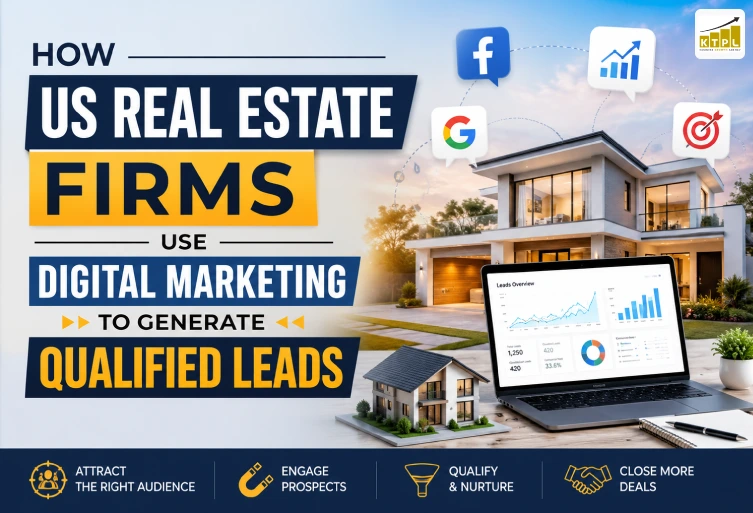
The way people buy, sell, and research real estate has changed significantly. Before contacting an agent, today’s buyers and sellers often spend hours searching online for properties, comparing neighborhoods, checking prices, reading reviews, watching property videos, and researching local market conditions. This shift has created a major opportunity for US real estate firms to reach potential clients much earlier in the decision-making process. Instead of depending only on referrals, traditional advertising, or property portals, real estate businesses can use digital marketing to attract people based on their location, interests, property requirements, and level of buying or selling intent. Search engine optimization can capture people actively looking for properties, paid advertising can reach high-intent prospects, social media can build awareness, and content marketing can answer questions before a prospect ever speaks with an agent. CRM systems and automated nurturing can then help businesses manage and qualify the inquiries they receive. The objective is not simply to generate thousands of leads. The real goal is to consistently attract qualified real estate leads that have genuine interest and a realistic possibility of becoming clients.
Why Digital Marketing Has Become Essential for US Real Estate Firms
Real estate decisions are rarely made after one advertisement or one website visit. A potential buyer may first search for a city, then compare neighborhoods, look at property prices, watch home tours, research mortgage costs, read reviews, and finally start comparing agents. Sellers often follow a similar process by researching property values, market conditions, selling strategies, and local professionals before deciding who to contact. This lengthy research process means that a real estate firm has many opportunities to build familiarity and trust before a prospect becomes sales-ready. US real estate firms that understand this journey can create content and campaigns for different stages rather than expecting every visitor to submit a contact form immediately. Someone in the early research stage may need an informative neighborhood guide, while an active buyer may be looking for specific listings or a property tour. A homeowner considering a sale may respond better to a valuation tool or local market report. Digital marketing makes it possible to provide different experiences based on user intent. When SEO, PPC, social media, content, retargeting, and CRM systems are connected, the business can create a more consistent path from online discovery to qualified inquiry. The difference between a lead and a qualified lead is particularly important in the real estate industry. A person can visit a website, download an article, or submit a form without having a clear intention to purchase or sell. If agents spend most of their time following up with low-intent contacts, the firm’s sales resources can quickly become inefficient. A stronger real estate lead generation strategy looks at signals such as location, property type, budget, timeline, pages viewed, property listings explored, repeat website visits, content downloads, and consultation requests. These signals can help businesses understand which prospects are actively moving toward a transaction and which are still researching. The goal is not to ignore early-stage prospects, but to give each prospect an appropriate level of attention. High-intent prospects can receive faster personal outreach, while early-stage contacts can receive useful educational content until they are ready to take the next step.
Local SEO Helps Real Estate Businesses Reach People Searching by Location
Real estate and location are inseparable, which makes local SEO one of the most valuable long-term marketing strategies for property businesses. People rarely search for real estate without some geographic context. They may search for homes in a particular city, condos in a specific neighborhood, properties near a school district, or a real estate agent serving a particular area. This creates opportunities for US real estate firms to build search visibility around cities, suburbs, neighborhoods, property types, and local services. Instead of relying only on broad terms such as “real estate company,” a firm can develop useful pages targeting searches such as “homes for sale in Austin,” “real estate agents in Phoenix,” “luxury homes in Miami,” or “sell my house in Dallas.” However, successful local SEO requires more than adding location names to repetitive pages. Searchers need genuinely useful information that helps them understand the market and make decisions. A strong local SEO strategy can include detailed neighborhood guides, local market updates, property-type pages, relocation resources, buyer education, seller information, and frequently asked questions. A neighborhood guide, for example, can explain the area’s housing options, lifestyle, amenities, transportation, general pricing trends, and factors buyers should consider. This type of content can attract people earlier in the research process while also introducing them to the firm’s local expertise. The same page can naturally connect readers with relevant property listings, consultation services, valuation tools, or additional guides. This creates a content journey rather than a single isolated webpage. For businesses competing in crowded real estate markets, building this type of local topical authority can be more valuable than publishing large amounts of generic content. Local visibility also extends beyond the website. A complete and accurate Google Business Profile can help a business appear in relevant local searches and provide potential clients with important information before they make contact. Accurate business details, appropriate categories, photographs, and genuine customer reviews can contribute to a stronger local presence. Reviews can be especially influential because real estate involves significant financial decisions and prospects naturally want reassurance before choosing a firm or agent. US real estate firms should maintain consistent business information across important platforms and respond professionally to genuine customer feedback. Local SEO should be treated as an ongoing process because markets, services, listings, and customer expectations change over time.
Paid Advertising, Landing Pages, and Retargeting Capture High-Intent Prospects
Organic search can provide valuable long-term traffic, but paid advertising gives real estate businesses another way to reach people who are actively searching for a property or service. PPC for real estate can be particularly effective when campaigns focus on high-intent searches rather than broad terms. A person searching for general housing trends may still be researching, while someone searching for “homes for sale in Tampa under $500,000” has already expressed a much clearer requirement. Search campaigns can therefore be organized around location, property type, buyer or seller intent, budget, and specific services. The advertisement should then match the user’s search and lead to a relevant landing page instead of sending every visitor to the company’s homepage. Landing pages are important because a homepage usually has to serve many different audiences. A buyer campaign could lead to a page offering property recommendations, while a seller campaign could focus on home valuation or a consultation. The page should explain the offer clearly, provide useful supporting information, establish trust, and make the next step simple. Forms can collect information such as name, email, phone number, preferred location, property type, budget, and timeline, but businesses should avoid asking for unnecessary information that creates friction. The objective is to make it easy for a genuinely interested prospect to continue the conversation. Not every visitor will convert during the first session, particularly in real estate where decisions often take weeks or months. Retargeting can help keep a firm visible to eligible previous visitors as they continue researching. Someone who viewed properties in a particular neighborhood could receive relevant property or market content later, while someone who explored seller resources could see information about valuation or listing preparation. The messaging should reflect the visitor’s previous interest rather than showing the same generic advertisement to everyone. When PPC, landing pages, and retargeting are connected, US real estate firms can create a more complete paid acquisition system that captures active demand while continuing to engage prospects who need more time.
Content, Social Media, and Video Build Trust Before the Sales Conversation
Real estate marketing is not only about showing properties. It is also about answering the questions people have before they feel comfortable making a decision. Buyers may want to understand neighborhoods, affordability, property taxes, financing, inspections, closing costs, and the buying process. Sellers may want to know how property values are determined, whether they should renovate, how to prepare for a listing, and what current market conditions mean for their property. Creating useful content around these questions allows US real estate firms to become a source of information rather than simply another company advertising its services. A strong content strategy can include market guides, neighborhood resources, buyer education, seller guides, property investment information, local trend articles, and detailed answers to frequently searched questions. The content should be written for people first, with search optimization supporting the information rather than controlling it. Each article should also have a natural next step. A neighborhood guide can link to current listings, a seller article can connect to a valuation service, and a buyer guide can lead to a consultation or property alert. This creates a logical relationship between informational content and commercial pages while supporting SEO and conversion. Social media provides another opportunity to build familiarity. Platforms such as Instagram, Facebook, YouTube, and LinkedIn allow firms to publish property highlights, market updates, neighborhood information, buyer advice, seller tips, and educational videos. Short-form content can be particularly useful for answering simple questions and introducing local expertise to people who may not yet be actively searching for an agent. Instead of measuring success only through likes or views, firms should consider whether social content encourages people to visit useful resources, explore properties, request information, or become familiar with the brand. Video can strengthen this strategy even further because property decisions are highly visual. Walkthrough videos can show layout and features, drone footage can provide neighborhood context, and virtual tours can help long-distance buyers explore properties before scheduling an appointment. Video can therefore help pre-qualify prospects by giving them more information before they speak with an agent. A person who has already watched a detailed property walkthrough may have a better understanding of the home and can ask more relevant questions during the next stage of the process.
CRM Automation and Lead Nurturing Turn Inquiries Into Opportunities
Generating a lead does not guarantee a sale. The period immediately after a prospect submits an inquiry can be extremely important because the person may also be contacting other agents or firms. A delayed response can result in a lost opportunity even when the original marketing campaign was successful. CRM systems help businesses organize contacts, track interactions, assign leads, record conversations, and manage follow-up activities. US real estate firms can use automation to send immediate confirmations, notify the appropriate team member, categorize prospects based on their interests, and begin relevant nurturing sequences. Automation should not make the customer experience feel robotic. Its purpose is to reduce repetitive administrative tasks and ensure that important inquiries are not forgotten. For example, a buyer who requests property information could receive a confirmation message followed by relevant listings and a simple invitation to speak with an agent. A seller who requests a valuation could receive information about the next steps while the sales team prepares for personal follow-up. This combination of automation and human communication creates a more consistent experience. Lead scoring can also help sales teams prioritize their time. A prospect who has viewed multiple properties, returned to the website, provided a budget, and requested a consultation may deserve faster personal attention than someone who has only read one article. CRM systems can use behavioral information to help organize these opportunities. AI-assisted scoring can support this process, although it should be treated as a decision-support tool rather than a perfect prediction of customer intent. Human judgment remains important, particularly for high-value real estate transactions. Longer sales cycles also make nurturing important. A person may be interested in buying but not ready for several months, or a homeowner may be considering selling but still preparing the property. Relevant email and SMS communication can keep the relationship active during this period. Buyers may receive market updates, new property alerts, and useful guides, while sellers may receive valuation information, preparation advice, and local market insights. The communication should remain useful and relevant rather than becoming a constant stream of sales messages.
Measuring Real Estate Marketing by Qualified Leads and Revenue
Digital marketing produces a large amount of information, but businesses need to measure the metrics that actually matter. Website traffic, impressions, clicks, and social engagement can show whether people are seeing a campaign, but they do not necessarily indicate whether the campaign is producing business. A real estate company could receive thousands of website visits and very few serious inquiries, while another campaign could generate a smaller number of leads but several valuable appointments. For this reason, US real estate firms should evaluate metrics such as cost per lead, qualified lead rate, appointment rate, cost per qualified opportunity, conversion rate, and revenue generated from different marketing sources. Tracking these numbers can reveal which locations, keywords, landing pages, advertisements, content topics, and audience segments are producing stronger results. Over time, the business can identify where marketing budget is creating genuine opportunities and where adjustments are needed. This also allows marketing and sales teams to work from the same information. Instead of asking only how many leads were generated, they can ask how many were qualified, how many became appointments, how many entered active negotiations, and which sources contributed to closed business. This measurement-first approach helps prevent marketing decisions from being based on vanity metrics. A campaign with fewer clicks may actually be more valuable if it attracts prospects who are more likely to buy or sell. The goal is to build a repeatable system in which marketing activity can be connected to actual business outcomes.
The Future of Digital Marketing for US Real Estate Firms
The future of real estate marketing will increasingly depend on how well businesses combine technology with useful, trustworthy information. Search engines, AI-powered discovery, local search, social platforms, video, automation, analytics, and CRM systems are becoming connected parts of the customer journey. This means US real estate firms need to focus on more than simply appearing online. They need to provide accurate local information, helpful answers, strong property experiences, clear conversion paths, and timely human support. The firms that perform well will not necessarily be those that publish the most content or spend the most on advertising. They will be the businesses that understand what their audience needs at each stage of the decision-making process. Someone researching a neighborhood needs different information from someone comparing listings, and an active seller needs a different experience from a first-time buyer. Digital marketing allows businesses to respond to these differences while using data to improve their approach over time. For KTPL- Business Growth Agency, the opportunity is to approach real estate marketing as a complete growth system rather than a collection of disconnected services. SEO, local search, content, PPC, social media, landing pages, CRM automation, and analytics can work together to create a measurable path from discovery to qualified inquiry. The exact strategy should always be adapted to the firm’s market, property segment, competition, audience, budget, and sales process. When technology handles repetitive tasks and data helps identify stronger opportunities, agents can spend more of their time doing what technology cannot replace: understanding clients, answering complex questions, building trust, negotiating, and helping people make important property decisions.
Conclusion
For modern US real estate firms, digital marketing is no longer simply a way to generate website traffic. It is a system for attracting the right audience, building trust, understanding intent, and creating qualified sales opportunities. Local SEO can capture people searching for specific markets, PPC can reach high-intent prospects, content can answer important questions, social media can build awareness, video can demonstrate properties, and retargeting can reconnect with interested visitors. CRM automation and lead nurturing can then help businesses manage relationships until prospects are ready for a meaningful conversation. The most important shift is from lead quantity to lead quality. A smaller number of relevant prospects can be more valuable than hundreds of inquiries with little genuine intent. By connecting marketing channels with strong content, useful landing pages, accurate data, timely follow-up, and human expertise, real estate firms can create a more predictable path from online discovery to real business.
Get discovered. Build trust. Capture interest. Qualify the prospect. Nurture the relationship. Create the opportunity.
That is the real potential of digital marketing for today’s US real estate industry.
FAQs
Have questions? We’ve answered some of the most common queries to help you understand the topic better.
Q1. How do US real estate firms generate qualified leads?
They use local SEO, PPC, content marketing, social media, video, landing pages, retargeting, and CRM-based lead nurturing to attract and qualify potential buyers and sellers.
Q2. Why is local SEO important for real estate?
Local SEO helps firms appear when potential clients search for properties, neighborhoods, agents, and real estate services in specific geographic areas.
Q3. Is PPC effective for real estate lead generation?
Yes. PPC can reach people with strong buying or selling intent when campaigns use relevant keywords, targeted locations, and focused landing pages.
Q4. How does CRM automation help real estate firms?
CRM automation organizes inquiries, tracks prospect behavior, manages follow-ups, and helps agents prioritize leads based on their level of engagement.
Q5. Can digital marketing increase real estate sales?
Digital marketing can increase qualified opportunities by connecting search, advertising, content, social media, and lead nurturing into one measurable customer journey.
Want To Grow Your Business - Connect With KTPL
KTPL – Business Growth Agency, a creative solutions and business growth agency from India.
👉 Visit https://kirnanitechnologies.com
📞 Call us at +91 95093 33000
📧 Email us at contact@kirnanitechnologies.com


