


How ClickUp Rapid Growth Started With a Strong Content Strategy
ClickUp Rapid Growth is a useful example of how a SaaS company can use SEO content to build visibility, attract organic visitors, and support product growth. Instead of depending only on product-focused pages, ClickUp expanded its content around productivity, project management, team collaboration, workflows, templates, software tools, and common business problems. This gave the company opportunities to appear for searches from users at different stages of the buying journey. Some visitors were looking for general productivity advice, while others were already searching for project management software or comparing specific platforms. This broad content approach helped connect informational searches with commercial opportunities. For businesses studying ClickUp Rapid Growth, the important lesson is not simply to publish a large number of articles. The stronger lesson is to create content that matches what people actually search for and then connect that content to relevant products, services, and conversion pages. A well-planned SEO content strategy can bring visitors into the website early and gradually introduce them to the company’s solution. ClickUp’s approach also demonstrates the importance of building content around search intent. Informational searches, commercial investigation searches, comparison searches, and transactional searches require different types of pages. A person searching for “how to manage team projects” needs educational information, while someone searching for “ClickUp vs Asana” is already evaluating software options. By creating content for both audiences, a brand can cover more of the customer journey. This type of full-funnel content strategy is particularly valuable for SaaS companies because customers often conduct considerable research before choosing software. For KTPL- Business Growth Agency, the ClickUp example provides a practical framework: identify customer questions, organize them by intent, create genuinely useful content, and connect each article to the next relevant stage of the buyer journey.
How High-Volume Content Helped Expand Organic Search Visibility
One major element behind ClickUp Rapid Growth was the development of a large content ecosystem covering many topics related to productivity and project management. Rather than restricting its blog to company news or direct product promotions, ClickUp created resources addressing different problems faced by teams, managers, businesses, and individual users. This type of content marketing strategy creates many entry points through Google and other search engines because each useful page can target a different question or keyword. Educational articles can capture top-of-funnel visitors, tool-related content can reach users researching solutions, and product-focused pages can help people who are closer to making a decision. The result is a website where multiple pages contribute to organic visibility instead of relying on one or two high-ranking keywords. However, high-volume publishing should not be confused with simply producing as many articles as possible. Content quality, topical relevance, search intent, internal linking, page experience, and useful information remain important. A website can publish hundreds of pages and still struggle if those pages do not answer the user’s actual question. The ClickUp Rapid Growth example is more useful when viewed as a content system rather than a publishing race. Businesses can apply the same concept at a smaller scale by identifying their most important topics and creating supporting articles around them. For example, a business targeting project management software could build content around project planning, task management, team productivity, workflow automation, templates, software comparisons, and alternatives. These related pages can strengthen topical coverage while giving users multiple ways to discover the brand through organic search. Another important part of this strategy is internal linking. When related articles are connected properly, users can move naturally from educational information to more specific resources. Search engines can also better understand the relationship between pages and the main topics covered by a website. A content hub about project management, for example, could connect articles about project planning, productivity tools, team collaboration, templates, and software comparisons. This creates a stronger website structure than publishing unrelated blog posts without a clear connection. For businesses looking to improve organic growth, this is one of the most practical lessons from ClickUp’s content strategy: create a connected library of useful information instead of treating every blog article as an isolated page.
Why Comparison Pages Became a Key Part of ClickUp Rapid Growth
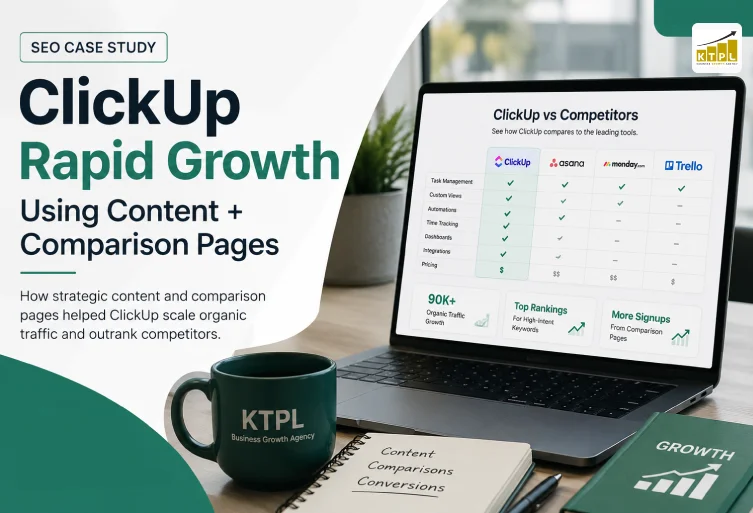
Comparison pages are another important part of ClickUp Rapid Growth because they target users who are already considering software solutions. A search such as “ClickUp vs Asana,” “ClickUp vs Trello,” or “ClickUp vs Monday.com” is very different from a general search such as “how to manage projects.” The user has already identified a category and is now evaluating alternatives. This makes competitor comparison keywords particularly valuable for SaaS companies. ClickUp has created comparison content around several project management platforms, giving potential customers information about features, workflows, integrations, use cases, and other product differences. A useful comparison page should make the research process easier rather than simply claiming that one product is better. Readers generally want to understand what each platform offers, where the products differ, which features are available, how pricing works, what type of team may benefit from each solution, and what switching might involve. A clear comparison table can make this information easier to scan. Feature categories can include task management, project views, automation, reporting, collaboration, integrations, templates, customization, and other relevant capabilities. This structure is valuable for both users and search engines because it presents specific information in an organized format. Competitor pages can also capture high-intent SEO traffic. Someone searching for a product comparison is often much closer to a purchase decision than someone reading a general productivity article. This does not mean every comparison visitor will convert, but the search intent is more commercially focused. Third-party analysis of ClickUp’s organic strategy has also highlighted competitor comparison content as an important part of its acquisition approach. For other SaaS companies, the lesson is to identify the competitors customers actually compare and create genuinely useful pages around those searches. Comparison pages can also target related search variations such as [Product] alternatives, [Product] vs [Competitor], best [category] software, [Competitor] alternatives, and project management tools for teams. These variations create additional opportunities to capture users who are evaluating different solutions. Instead of creating thin pages for every keyword variation, businesses should build comprehensive resources that answer multiple closely related questions. This approach supports semantic SEO while keeping the website useful for real visitors.
How ClickUp Connected SEO Content With Product Growth
The most valuable lesson from ClickUp Rapid Growth is that content was not treated as a completely separate marketing activity. The content journey could lead users toward templates, product features, comparisons, migration information, and other resources related to using the platform. This creates a connection between organic search and the actual product experience. Someone might first discover ClickUp through an educational article, later read a comparison page, explore templates, and eventually investigate the product itself. Each interaction can move the visitor further through the customer journey. This is where product-led growth and SEO content can complement each other. Product-led growth allows users to experience a product and understand its value, while content can attract those users before they have decided which product to use. The combination can create a strong acquisition cycle when the content answers real problems and the product provides a relevant solution. Comparison pages can become especially important because they reach visitors who are already considering alternatives. Clear migration information, product demonstrations, templates, feature explanations, and simple calls to action can reduce friction for users who are interested in making a switch. The same principle can be applied outside the SaaS industry. A service company can create educational articles that answer customer questions and then guide readers toward relevant services. An e-commerce company can publish buying guides and comparison pages before directing visitors toward product categories. A B2B company can create technical resources that educate prospects before introducing its solution. The strategy is therefore not limited to ClickUp or software businesses. It is a broader SEO and content marketing framework for turning search visibility into meaningful business opportunities. For KTPL, the key takeaway is that content should have a purpose beyond generating page views. Each important article should answer a real search query, build topical authority, support the user’s next question, and provide a natural path toward a relevant business solution. This creates a more useful website for both search engines and visitors. It also gives businesses a practical way to build long-term organic visibility without relying entirely on paid traffic.
What Businesses Can Learn From ClickUp Rapid Growth
The ClickUp Rapid Growth strategy provides several practical lessons for businesses that want to improve their organic search performance. First, content should be created around real customer problems rather than keywords alone. Second, websites should cover different stages of the buying journey, from educational searches to commercial comparisons. Third, competitor pages can be valuable when they provide accurate, detailed, and genuinely useful information. Fourth, internal links should connect related content so visitors can move naturally through the website. Finally, content should be connected to the company’s actual products, services, resources, and conversion opportunities. Businesses do not need to copy ClickUp’s publishing volume to apply these principles. A smaller website can focus on creating fewer but stronger pages that target valuable topics. A focused content strategy may include educational guides, comparison pages, alternatives pages, templates, service pages, FAQs, and supporting resources. Each page can target a specific intent while contributing to the wider topic structure of the website. This approach can support SEO, AEO, and GEO because the content is organized around direct questions, clear answers, related entities, and useful context rather than keyword repetition. For answer-focused search, pages should provide direct explanations that can easily answer questions such as “How did ClickUp grow?”, “Why are comparison pages important?”, and “How does content marketing support SaaS growth?” For generative search, the content should provide clear definitions, specific examples, contextual relationships, and trustworthy information. For traditional SEO, the focus should remain on relevance, quality, technical performance, internal linking, and a strong user experience. Combining these principles makes content more useful across Google Search, AI-powered search experiences, and other discovery platforms. Ultimately, ClickUp Rapid Growth shows that organic growth can come from building a complete content ecosystem rather than relying on one type of article. Educational content attracts people who are still researching, comparison pages reach people evaluating products, and product-related resources help interested visitors move closer to action. The strongest strategy is therefore not simply “publish more.” It is to publish the right content for the right search intent, connect those pages intelligently, keep important information updated, and make every page genuinely useful to the person reading it.
FAQs
Have questions? We’ve answered some of the most common queries to help you understand the topic better.
Q1. What is ClickUp Rapid Growth?
ClickUp Rapid Growth refers to the company’s expansion supported by content marketing, SEO, product-led strategies, and other customer acquisition methods.
Q2. How did content support ClickUp's growth?
ClickUp created content around productivity, project management, templates, workflows, software tools, comparisons, and other topics that matched customer search intent.
Q3. Why are ClickUp comparison pages important?
Comparison pages target users who are actively evaluating ClickUp against competing software such as Asana, Trello, and Monday.com.
Q4. Can small businesses use the ClickUp SEO strategy?
Yes. Businesses can apply the same principles at a smaller scale by creating useful topic-focused content and comparison pages based on customer needs.
Q5. What is the main lesson from ClickUp Rapid Growth?
The main lesson is to combine useful content with search intent, comparison resources, internal linking, and relevant product or service journeys.
Want To Grow Your Business - Connect With KTPL
KTPL – Business Growth Agency, a creative solutions and business growth agency from India.
👉 Visit https://kirnanitechnologies.com
📞 Call us at +91 95093 33000
📧 Email us at contact@kirnanitechnologies.com


